

by Ioana Maria Cortea — Published on November 27, 2026 — Reading time: 8 min

Part of the INFRA-ART FAIR Journey article series
Article sections
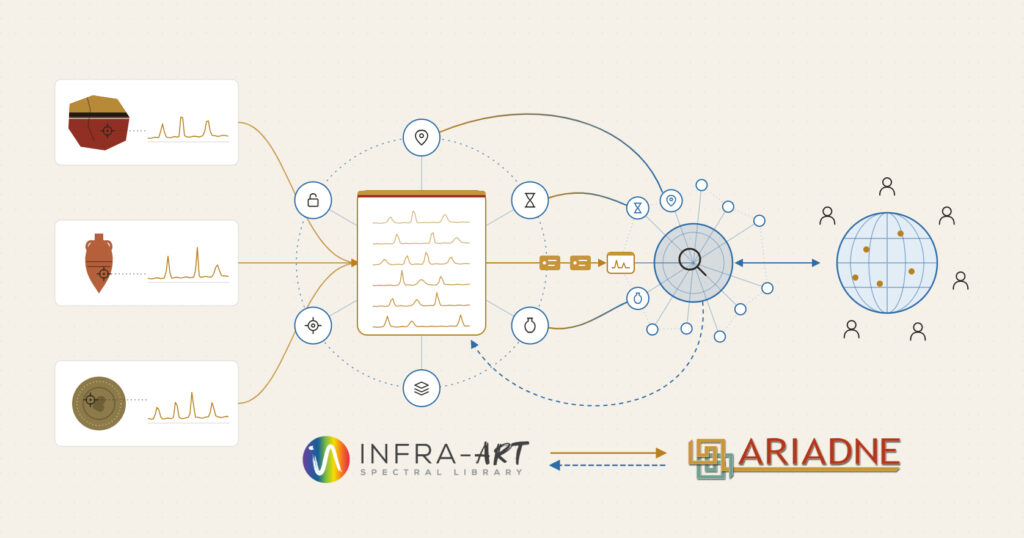
In 2027, we plan a major upgrade to the INFRA-ART Spectral Library that will expand its scope beyond reference materials to include analytical data from historical and archaeological artefacts. Our aim is to make these new collections discoverable through the ARIADNE portal. This transition introduces new requirements for representing relationships between objects, samples or analysis points, archaeological contexts, and associated research information. In this article, we look at how we began preparing INFRA-ART metadata for integration into ARIADNE at the Archaeology Data Service (ADS) training school in York and how this work informed the conceptual model we presented at the 12th Linked Pasts Symposium in Porto.
From refrence materials to archaeological objects
The current INFRA-ART collections primarily document reference materials. As we prepare to expand them to include data from historical and archaeological objects, we need to document how individual measurements relate to the object and its context. For a wall painting fragment, for example, this means recording where it was found, how it was dated and which parts of its surface were analyzed. Several techniques may be used at the same point, while measurements at different locations may capture different paint layers or surface features. Recording the sample or analysis point for each measurement helps researchers interpret the results alongside other findings and documentation for the fragment.
This shift in how we document analytical data also addresses a gap in the wider archaeological data ecosystem. Scientific measurements are often documented separately from the records that describe the objects and the contexts in which they were found. This makes it harder to find analytical data by site, period or object type and to trace an individual measurement back to the sample or area analyzed. By linking analytical and archaeological records through shared metadata models and vocabularies, we aim to make these datasets discoverable through the ARIADNE portal. Researchers could then follow a search result in ARIADNE to the corresponding measurement records in INFRA-ART.
Preparing metadata for integration into ARIADNE
At the ADS Transnational Access Training School, held in York from 12 to 16 October 2026, we began exploring how to prepare metadata from INFRA-ART’s planned collections for integration into ARIADNE. The portal provides a common point of access to archaeological resources held by different institutions. To make our collections discoverable there, we need to structure and map their metadata so that ARIADNE can interpret it alongside records from other providers. The training covered Linked Open Data and semantic mapping, including how to align local metadata with shared models such as CIDOC CRM and AO-Cat, ARIADNE’s catalogue ontology.
For INFRA-ART, this meant looking at which metadata could support discovery across collections and how those fields would link to more detailed records in the library. Information such as site, period and object type could help researchers find relevant datasets through ARIADNE. The corresponding INFRA-ART records would retain the detail needed to interpret individual measurements, including the precise location of the analysis point, the technique used and the acquisition conditions.
| Block | Archaeological sample | Alignment |
| Identification | Sample ID · Sample type: Historical / archaeological sample · Collection · Other identifiers (field, inventory number) | Collection as the organising unit |
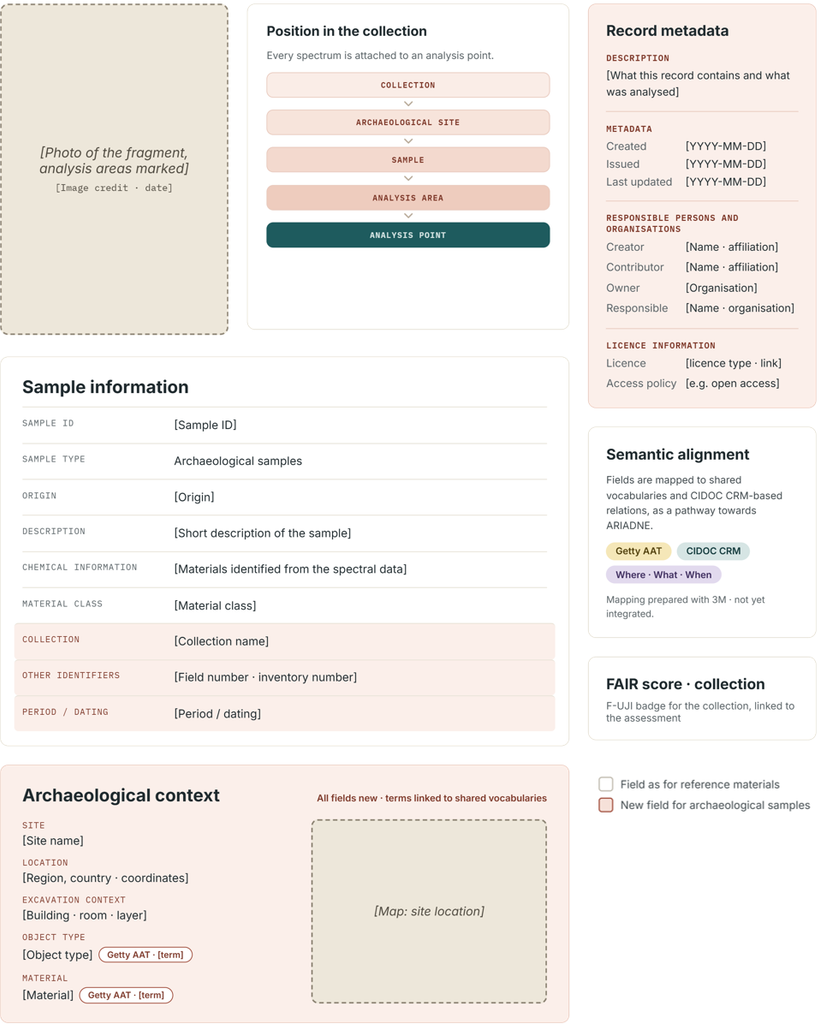
| Hierarchy | Collection → Site → Object/Sample → Analysis area → Analysis point; spectrum and metadata at the point | CIDOC CRM-based part-of relations |
| What | Material class · Chemical information · Object type · Material terms linked to a vocabulary | What · Getty AAT |
| When | Period / dating of the object or context | When · period vocabulary |
| Where | Site · Location (coordinates) · Excavation context | Where · place |
| Description and metadata | Description · Created · Issued · Last updated | Record-level metadata |
| Responsible persons and organisations | Creator · Contributor · Owner · Responsible | Agents and roles |
| Licence and access | Licence information · Access policy, per collection | Rights statement |
| Spectral data | Attached to the analysis point within an object | Unchanged content, new anchor |
Linking analytical and archaeological records
Building on the work started in York, we presented the poster Towards a Linked Heritage Science Repository: Connecting INFRA-ART to the Archaeological Data Ecosystem at the 12th Linked Pasts Symposium, hosted by the Centre for Digital Culture and Innovation (CODA), at the University of Porto, between 23 to 25 November 2026. The poster outlined a conceptual model for organizing analytical datasets and linking them to their archaeological context.
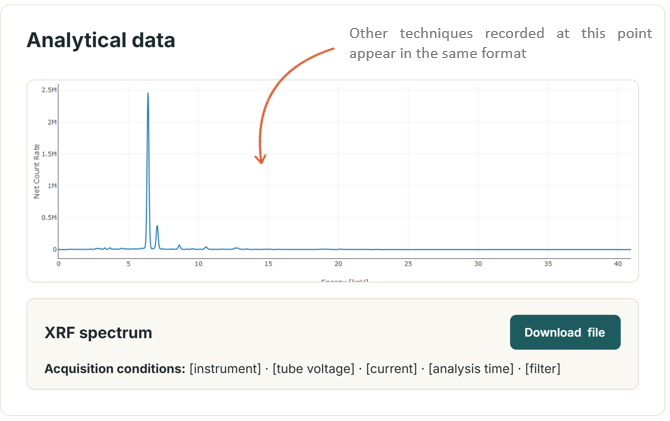
The proposed model follows the hierarchy collection → site → sample → analysis area → analysis point. The sample record brings together contextual information such as the find location, excavation context, period, object type and material. It also documents the areas examined, which can be marked on a photograph of the sample. Within each area, the record identifies the individual analysis points and links each point to its measurements, with the analytical data, technique and acquisition conditions recorded for each measurement. The metadata also identify the data creator and sample owner and specify the applicable licence and access policy. We plan to map selected metadata terms to shared vocabularies, including the Getty Art & Architecture Thesaurus (AAT). Researchers will be able to search these collections in INFRA-ART by keyword or Getty AAT term and filter the results by object type and data type.
Pilot collection and next steps for INFRA-ART
We will test the proposed model on a pilot collection of Roman wall painting fragments excavated from several archaeological sites in present-day Romania. The pilot will help us assess how well the model captures archaeological context and analytical details, and identify where it needs refinement. Our aim for 2027 is to add the datasets to INFRA-ART and map their metadata to ARIADNE’s catalogue model so that researchers can find them through the ARIADNE portal.
This pilot will also inform the longer-term development of INFRA-ART towards an open, community-driven heritage science repository. Working with the collection will help us define what future contributors need to document when depositing analytical datasets, from the provenance of an object and the location of each measurement to the conditions for accessing and reusing the data. These requirements will give contributors a practical basis for preparing datasets that other researchers can find, interpret and reuse.
About the ARIADNE portal
The ARIADNE portal brings together catalogue records for more than four million archaeological resources held by different institutions, including excavation reports, scientific datasets, and records of sites, monuments and individual artefacts. Researchers can search by keyword or explore the catalogue by where (place or map area), when (date range or named period) and what (subject). They can also narrow results by resource type.
To make collections searchable together, ARIADNE maps metadata from different providers to a common model, the ARIADNE Object Catalogue (AO-Cat), based on CIDOC CRM. Shared vocabularies such as the Getty Art & Architecture Thesaurus help researchers find related records even when providers use different terms. The catalogue can link users to the original resource, while the data remain with the provider.
For INFRA-ART, integration with ARIADNE would allow researchers to find analytical datasets by archaeological context. A researcher looking for Roman wall paintings from a particular site within present day Romania could discover which fragments had been analysed, then follow a link to INFRA-ART to see where on each fragment measurements were taken and examine the associated spectra.
Our conceptual model is still in the design phase. As we develop the pilot, we welcome feedback on the proposed approach and practical advice on implementing it within the INFRA-ART platform and mapping our metadata for discovery through ARIADNE.

Further reading and resources
ARIADNE Research Infrastructure. https://portal.ariadne-infrastructure.eu/
Cortea, I. M. (2026). Towards a Linked Heritage Science Repository: Connecting INFRA-ART to the Archaeological Data Ecosystem [Poster]. 12th Linked Pasts Symposium, 23–25 November 2026, Porto, Portugal. https://doi.org/10.5281/zenodo.24552527
Felicetti, A., Richards, J., Theodoridou, M., Bardi, A., and Pagé-Perron, É. (2026). ARIADNE Ontology (AO-Cat) rdfs. ARIADNE Research Infrastructure AISBL. https://doi.org/10.5281/zenodo.21476360
Ferreira-Lopes, P., and González-Gracia, E. (2025). Performing a Systematic Literature Review on the Implementation of the CIDOC CRM in Cultural Heritage. Journal on Computing and Cultural Heritage, 18(4), 1–16. https://doi.org/10.1145/3771098
Geser, G. (2023). Achievements of the ARIADNE Initiative for Archaeological Data Sharing and Research. Internet Archaeology, 64. https://doi.org/10.11141/ia.64.2
Schmidt, S. C., Thiery, F., and Trognitz, M. (2022). Practices of Linked Open Data in Archaeology and Their Realisation in Wikidata. Digital, 2(3), 333–364. https://doi.org/10.3390/digital2030019
Theodoridou, M. (2016). Methodological tips for mapping to CIDOC CRM [Presentation]. 36th CIDOC CRM SIG meeting and 29th FRBR–CIDOC CRM Harmonization Meeting, Heraklion, Greece. Available online

How to cite this resource
Cortea, I.M. (2026, November 27). Preparing INFRA-ART’s upcoming collections for integration into the ARIADNE portal. INFRA-ART Blog. https://blog.infraart.inoe.ro/2026/11/27/preparing-infra-arts-upcoming-collections-for-integration-into-the-ariadne-portal/