

by Luminița Ghervase — Published on November 11, 2026 — Reading time: 10 min

Part of the Guest Contributions in Heritage Sciencey article series
Article sections
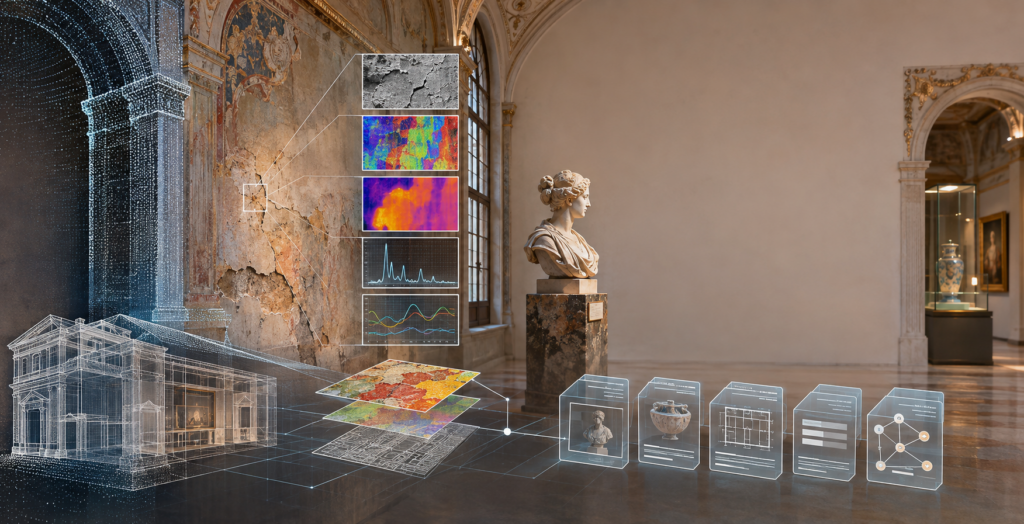
A single study of a historic building that houses a museum collection can generate a wide range of data, from 3D scans and spectra to microclimate records. How can future teams make sense of these different types of data and use them together? This article outlines practical steps for applying the FAIR principles to bring measurements, metadata, and documentation together in reusable data packages that can inform conservation decisions for both the building and its collection.
Cultural heritage in the data era
Historic buildings housing collections are multi-component systems whose cultural value resides both in their architecture and decorative elements and in the objects they contain. The technological advances and the growing interest in digital technologies now allow increasingly large volumes of data to be acquired from multiple sources. For a single case study, multiple types of data can be gathered simultaneously, offering information on building geometry, imaging, point analysis, microclimate, or derived products, such as, but not limited to, those listed in the table bellow.
| Category | Types of data |
| Building geometry | 3D scans (point clouds), (H-)BIM models, structural models |
| Imaging | High-resolution photographs, multi/hyperspectral images, UV images, thermal images |
| Point-based analysis | XRF, LIBS, Raman, FTIR |
| Environmental conditions | microclimate data |
| Derived products | degradation maps, distribution maps, textured models, orthophotoplans, classifications |
As a result, different types of information may be produced, coming from different sources, with different structures and spatial, temporal, and spectral resolutions, but which describe the same physical reality – the collection objects and the building housing them. Taken separately, each data type provides part of the overall picture; correlated into a coherent digital package, they can answer questions that individual techniques alone could not. For example, in a historic building that operates as a museum, a degraded wall can be simultaneously investigated using multiple techniques and the integration of the results into a FAIR digital package would allow a better understanding of the relationship between the construction materials, the state of conservation and the microclimate parameters, but also of the way that particular form of degradation can affect the objects inside the building. Such correlations can support the conservation decisions for both the building and the collection.
Why is FAIRification needed?
Since their formulation in 2016, the FAIR (Findable, Accessible, Interoperable, Reusable) principles have become an international benchmark for the management of research data. Applying these principles to such datasets can transform them into reusable resources. Today, FAIR implementation is increasingly becoming a practical condition for improving the efficiency and preservation of the research outputs. Data FAIRification involves assigning persistent identifiers, associating standardized metadata, documenting acquisition and processing methods, using interoperable formats, and publishing data in digital infrastructures capable of ensuring long-term access and reuse. Data described and published in a consistent manner can be compared even between different projects and can support automated analysis methods.
However, FAIR data does not necessarily imply OPEN data. Because heritage professionals sometimes work with sensitive information – such as the location of storage facilities or security systems – the principle of “as open as possible, as closed as necessary” should be applied. Therefore, this type of information must remain under controlled/limited access, provided that access conditions are clearly specified.
What does a FAIR digital package look like?
A FAIR digital package brings together data, documentation, results, and information on use rights and permissions, organized in such a manner that a person outside the team that produced them can understand, verify and reuse them. For historic buildings hosting museum collections, such a package may include:
- Primary and derived data, such as those listed earlier, and interpretative data that integrate primary and processed data into reports, conservation assessments, intervention recommendations, best-practice guides;
- Descriptions, including metadata that document the context of data acquisition, equipment used, experimental parameters, processing conditions, and methodologies for reproduction and verification of results;
- Administrative content, including persistent identifiers (PIDs) to facilitate data discovery and citation, usage rights and access licenses, and explicit links between the building, exhibition/storage spaces, collection objects, and associated digital resources, enabling the relationships among them to be tracked.
Anyone who has tried to compare results from 3D scans, hyperspectral images, and spectroscopic information knows how difficult it can be when each type of output is organized differently. Therefore, for data from such diverse sources to be understood and reused together, they must be described using common metadata and conceptual models. In this context, conceptual models such as CIDOC CRM and the Europeana Data Model (EDM) may be used, alongside Linked Open Data-based approaches and controlled vocabularies dedicated to cultural heritage, such as those developed by Getty. All these models, standards, and vocabularies address complementary needs and allow the explicit representation of the relationships between buildings, objects, conservation events, performed investigations, and results. CIDOC CRM and EDM models provide the backbone by defining how concepts are linked. Dedicated heritage vocabularies provide the content placed upon this framework, namely the terminology used to describe materials, techniques, and places in a consistent manner. National ontologies, such as ArCo, adapt international standards to local requirements. H-BIM models and the IFC standard address building modelling and description, supporting the integration of both geometric and semantic information.
| Model/standard | Role | Example of use |
| CIDOC CRM | Large-scale, event-oriented conceptual model, aimed at deep integration of research and scientific results | Links the building, collection objects, and the performed investigations |
| → CRMsci: CIDOC CRM extension for scientific observations; allows documentation of analyses: instrument, parameters, results | ||
| → CRMdig: CIDOC CRM extension for digital data provenance, for tracking datasets from acquisition through processing to publication | ||
| → CRMba: CIDOC CRM extension for buildings, for documenting components and construction phases | ||
| EDM | Medium-scale, object-oriented model, focused on web aggregation and large-scale interoperability | Publishing object descriptions in European portals or aggregators |
| Linked Open Data | Publishing interconnected data, in machine-readable open format | Connecting local datasets with other cultural heritage datasets |
| Getty Vocabularies | Controlled vocabularies for cultural heritage | Consistent description of materials, techniques, and locations |
| → AAT (Art & Architecture Thesaurus): Multilingual vocabulary of terms, sources, and relationships for concepts related to art, architecture, conservation, and cultural heritage | ||
| → TGN (Thesaurus of Geographic Names): Global vocabulary of place names, relationships, sources, and coordinates for historic and contemporary places associated with art and heritage | ||
| → ULAN (Union List of Artist Names): International vocabulary of names, relationships, sources, and biographical information related to artists, architects, and organisations | ||
| H-BIM | Historic Building Information Modelling | 3D information model of the building to which other data are linked |
| ArCo | National ontology (Italian cultural heritage) that reuses and maps CIDOC CRM and EDM concepts | Example of bridge between international standards and local requirements |
Challenges in multimodal data management
Data organization. One of the main challenges derives precisely from the diversity of the information – all these various datasets must be organized and correlated so that they describe both the building and the objects contained within, in a meaningful manner, at the time of their creation but also in the future. The reality is that, oftentimes, such large volumes of data remain fragmented, scattered across external hard drives or folders stored locally or on network drives, making them difficult to identify even for the team that created them. There are currently efforts to find solutions to this problem, both at European and international level.
Required infrastructure. 3D scans or hyperspectral images can easily generate tens or even hundreds of GB of data for a single case study. Medium- and long-term storage, processing and ensuring their security requires dedicated infrastructures that are not easily available for all museums or institutes. Moreover, traceability must also be taken into account – each record must be linked to the analyzed building or object under investigation and to the conservation conditions at the time it was created.
Costs. FAIRification of digital data packages requires additional time, expertise, and financial resources and, in many projects, data management activities are still considered secondary activities. A possible solution is to include data management activities into the project plan from the start, with dedicated time and budget allocation.
Where to start?
The first steps do not require complicated infrastructure. A few simple measures, implemented from the beginning of a project, can improve data interoperability and reuse, although they do not automatically guarantee full FAIR compliance. The first step is to publish datasets in repositories that assign persistent identifiers such as DOIs, so that datasets can be discovered and cited. The second step is to coherently combine the files, metadata, and methodological descriptions in an integrated package that is readable by both humans and machines. The formats used should be publicly documented and independent of any specific software package so that the results can be identified and accessed over the long term, even decades after their creation. After publishing the first dataset, tools such as F-UJI or O’FAIRe can be used to evaluate compliance with FAIR principles and to identify gaps and opportunities for improvement.
Conclusions
A spectral dataset, a thermal map, or a 3D model can provide far greater value together than individually, but only if they can still be found, understood, and compared years after their creation. The steps outlined above are technically straightforward, and most of the required tools are freely available. Reconstructing documentation after a project has ended generally costs more than documenting data properly from the start. For historic buildings housing museum collections, a FAIR data package may ensure that measurements acquired today can be verified or compared with future observations, thus supporting informed conservation decisions.
The real cost is not primarily that of software tools or infrastructure but rather the time and expertise required. For small museums and research institutes that lack dedicated data-management personnel and do not have budgets allocated for these activities, this remains an open challenge.

Further reading and resources
Amdouni, E. et al. (2022). O’FAIRe makes you an offer: Metadata-based Automatic FAIRness Assessment for Ontologies and Semantic Resources. International Journal of Metadata, Semantics and Ontologies, 16(1): 16-46. https://doi.org/10.1504/IJMSO.2022.131133
Carriero, V. A., et al. (2019). ArCo: The Italian Cultural Heritage Knowledge Graph. In The Semantic Web – ISWC 2019 (pp. 36–52). Springer International Publishing. https://doi.org/10.1007/978-3-030-30796-7_3
Devaraju, A., and Huber, R. (2025). F-UJI – An Automated FAIR Data Assessment Tool (v3.5.0). Zenodo. https://doi.org/10.5281/zenodo.15118508
Doerr, M. (2003). The CIDOC CRM: An ontological approach to semantic interoperability of metadata. AI Magazine, 24.
EOSC-Pillar. Integrating heterogeneous data on cultural heritage. https://www.eosc-pillar.eu/use-cases/integrating-heterogeneous-data-cultural-heritage
European Commission. The common European data space for cultural heritage – Strategy 2025–2030. European Commission strategy
O’Neill, B., and Stapleton, L. (2022). Digital cultural heritage standards: From silo to semantic web. AI & Society, 37(3), 891–903. https://doi.org/10.1007/s00146-021-01371-1
Vermeulen, M., et al. (2022). XRFast: A new software package for processing of MA-XRF datasets using machine learning. Journal of Analytical Atomic Spectrometry, 37(10), 2130–2143. https://doi.org/10.1039/D2JA00114D
Wilkinson, M., et al. (2016). The FAIR Guiding Principles for scientific data management and stewardship. Scientific Data 3, 160018. https://doi.org/10.1038/sdata.2016.18

How to cite this resource
Ghervase, L. (2026, November 11). FAIR data for historic buildings and their collections: from complex measurements to reusable digital packages. INFRA-ART Blog. https://blog.infraart.inoe.ro/2026/11/11/fair-data-for-historic-buildings-and-their-collections-from-complex-measurements-to-reusable-digital-packages/