

by Ioana Maria Cortea — Published on June 8, 2026 — Reading time: 9 min

Part of the INFRA-ART FAIR Journey article series
Article sections
One year ago, we started the FAIRification process of the INFRA-ART Spectral Library. What began as a response to a series of interoperability, metadata, and governance challenges gradually evolved into a broader process of learning, collaboration, and transformation.
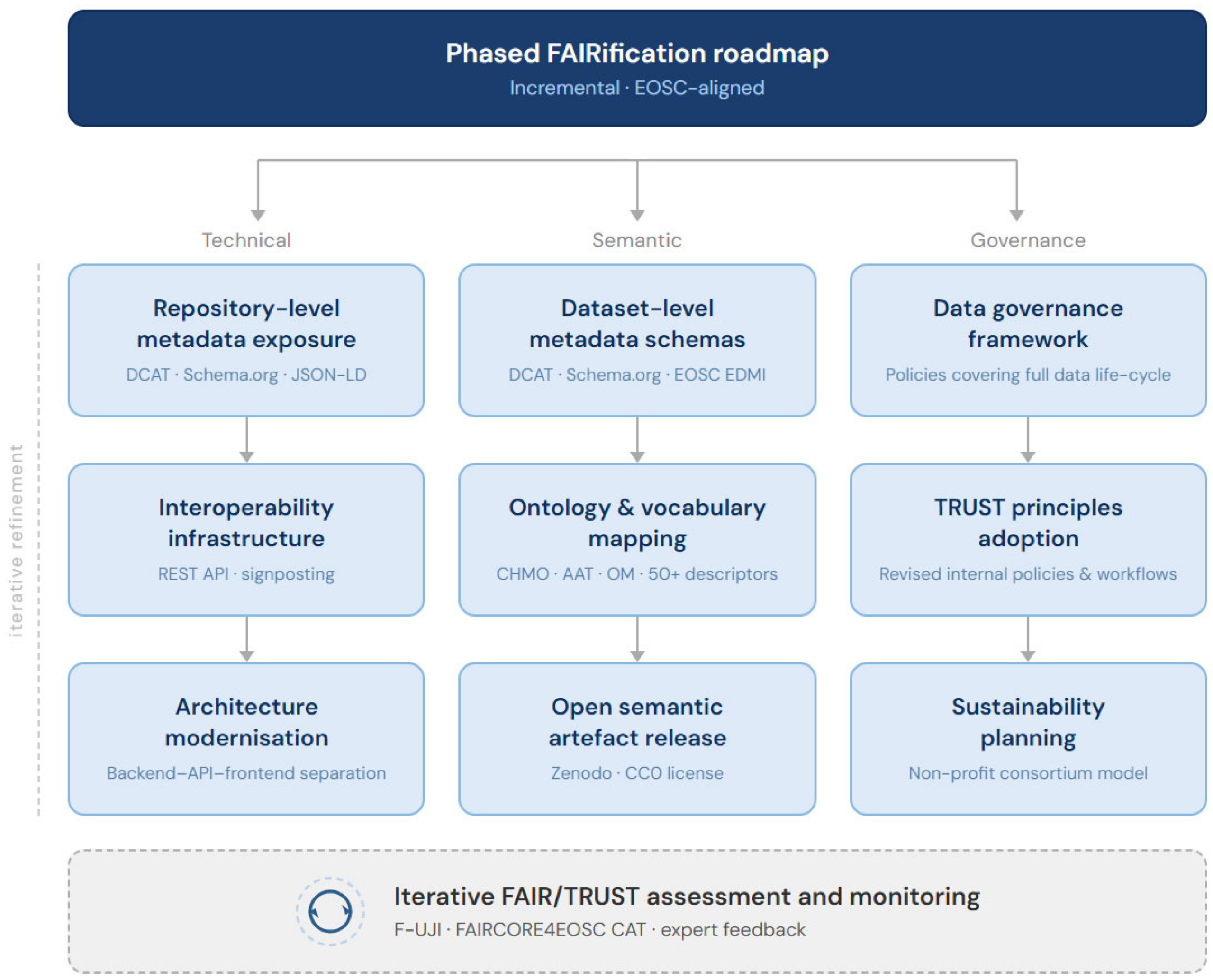
This FAIRification effort recently culminated in the publication of an implementation case study in Heritage, SI: Advances in Digital Heritage Preservation and Open Science. The paper presents a roadmap-driven FAIRification approach, aligned with the EOSC Interoperability Framework and complemented by the TRUST Principles, offering practical insights for FAIR implementation across diverse research contexts.
Importantly, the publication process also provided an opportunity to reflect on what FAIRification actually looks like in practice within a small, long-tail heritage science data service. This blog post shares some of the key lessons and challenges that emerged along the way—many of which extend beyond what could be covered in the original manuscript.
FAIRification is not a one-time technical fix
When we started the FAIRification of the INFRA-ART data service, we initially viewed it primarily as a technical challenge. Our focus was on implementing machine-actionable metadata, exposing structured information through standard protocols, and improving FAIR assessment scores. These technical improvements were certainly necessary, but they proved to be only part of a much more complex process.
As the implementation journey unfolded, new questions emerged. How should the datasets be described to support meaningful reuse? Which standards and vocabularies should be adopted? How should responsibilities for maintaining metadata and documentation be allocated? How could FAIR improvements be sustained beyond the lifetime of a specific project or funding cycle?
What began as a technical interoperability exercise gradually expanded into a broader discussion about governance, sustainability, documentation, community engagement, and long-term stewardship. Perhaps the most important lesson learned was that FAIRification is not a one-time technical intervention or a box-ticking compliance exercise, but rather an ongoing process of refinement, negotiation, and adaptation.
Following a roadmap
Another important lesson from the FAIRification process was the value of working within a structured and interoperability-oriented roadmap. Rather than pursuing isolated technical improvements, the roadmap provided a framework for prioritizing actions, coordinating implementation efforts, and ensuring that individual improvements contributed to broader FAIR objectives.
The roadmap also encouraged an incremental approach to FAIRification. Rather than attempting to address all FAIR requirements at once, improvements were implemented progressively, focusing first on actions that offered the greatest impact relative to available resources. Equally important was the role of automated FAIR assessment tools to help identify implementation gaps, establish priorities, and monitor progress throughout the process. While such tools cannot capture every aspect of FAIRness, they proved valuable as diagnostic instruments and sources of practical guidance.
Machine-actionable metadata as a foundation
At first glance, improving metadata may seem like a relatively straightforward task. In practice, however, it required us to rethink how datasets were described, discovered, interpreted, and ultimately reused. Questions that initially appeared simple quickly became more complex. What metadata schemas should we use? Which metadata elements should be mandatory? How can local terminology be aligned with broader community standards without losing important contextual information?
Developing structured metadata schemas forced us to take a closer look at the data itself. In many cases, improving metadata meant clarifying concepts, standardizing terminology, documenting workflows, and making implicit knowledge explicit.
The FAIRification process also prompted broader reflection on the relationship between FAIRness and data quality. FAIR data are not inherently “better” scientific data in terms of their intrinsic quality or validity. However, FAIRification can improve transparency, traceability, and reproducibility by making data, metadata, and associated workflows more visible and better documented.
Interoperability is more than a technical problem
While structured metadata provided an essential foundation for transparency, discoverability, and initial machine-actionability, achieving more advanced levels of FAIRness required semantic enrichment at the level of individual datasets. This proved considerably more challenging than anticipated.
Developing semantic mappings for the INFRA-ART Spectral Library required much more than selecting existing standards and applying them to our datasets. Choosing appropriate vocabularies, aligning local concepts with community practices, and representing domain-specific knowledge in a machine-actionable way often involved interpretation, judgement, and compromise.
Many implementation decisions did not have a single correct answer. Different standards offered different possibilities, and balancing local requirements with broader interoperability objectives required careful consideration. In this context, expert feedback and engagement with the wider research data management community proved invaluable. Decisions regarding metadata granularity also became increasingly important, requiring a balance between rich semantic descriptions and the practical realities of maintaining them over time. Interoperability therefore emerged not only as a technical endpoint, but as an ongoing process of semantic alignment and refinement.
Governance and long-term sustainability
When discussing FAIR implementation, attention is often directed toward technical solutions: metadata schemas, APIs, persistent identifiers, or semantic mappings. Yet one of the less visible—and perhaps most underestimated—aspects of FAIRification concerns governance.
As the FAIRification process progressed, it became increasingly clear that technical improvements alone were not enough. Questions emerged around policies, documentation, quality assurance procedures, and the allocation of responsibilities for maintaining and updating the service over time.
| Dimension | Implemented mechanism | Outcome |
| Technical interoperability | RESTful API | Programmatic access and metadata exchange |
| Data governance | Public data policies | Transparent governance and curation practices |
| Responsibility | Defined stewardship roles | Clear allocation of responsibilities |
| Trustworthiness | FAIR assessment (F-UJI) | Measurable FAIR progress |
| User focus | Open documentation on Zenodo | Greater transparency and long-term access |
These discussions were not always straightforward. For small, long-tail research infrastructures, resources are often limited, teams are small, and responsibilities may evolve over time. Ensuring that FAIR improvements remain sustainable beyond a specific project or funding cycle can therefore be as challenging as implementing the technical solutions themselves. Some of the most difficult FAIRification questions we encountered were not technical at all. They concerned long-term stewardship, sustainability, and the organizational capacity needed to maintain FAIR practices over time. We learned that FAIRification ultimately depends not only on technology, but also on the governance structures that support its long-term viability.
The value of community support
The FAIRification of the INFRA-ART Spectral Library did not happen in isolation. Throughout the process, training activities, FAIR support programmes for the adoption of solutions, and interactions with the wider research data management community provided valuable guidance and feedback. Participation in FAIR-IMPACT, FIDELIS and RDA-TIGER support actions proved particularly beneficial. These support mechanisms helped build internal expertise, provided opportunities for feedback, and exposed us to implementation experiences from other infrastructures facing similar challenges. For smaller research infrastructures like ours, this type of support has significantly accelerated progress while strengthening the internal capacity needed to carry FAIRification forward.
Publishing FAIRification work
The publication of our FAIRification case study represents an important milestone for the INFRA-ART Spectral Library, but not the end of the FAIRification process. Several areas identified during the implementation remain subject to future refinement.
Looking back, one of the most unexpected lessons emerged not from the FAIRification process itself, but from the experience of publishing it. The manuscript presents a context-sensitive implementation case study, documenting the FAIRification of a specific long-tail heritage science data service. During the review process, however, this context-sensitive approach led to questions regarding the broader scientific contribution of the work, and the paper was rejected before eventually finding its place in the literature.
In many ways, this reflects a broader challenge within open science. FAIR implementation is rarely linear, complete, or universally applicable. It evolves through incremental improvements, adaptation, and continuous learning. What works in one context may not work in another.
For this reason, implementation experiences matter. They help make FAIRification more transparent, provide practical examples for others facing similar challenges, and contribute to a growing body of knowledge that extends beyond technical specifications and policy recommendations. In the end, achieving FAIRness is less about reaching a particular maturity level and more about establishing a framework for continuous improvement.

Further reading and resources
Cortea, I.M. (2026). From FAIR Principles to Practice: A Case Study of FAIRification in a Heritage Science Data Service. Heritage 9, 228. https://doi.org/10.3390/heritage9060228
Cortea, I. M. (2025). Semantic Artefact Documentation for the INFRA-ART Spectral Library Datasets and Data Catalog (1.0). Zenodo. https://doi.org/10.5281/zenodo.17570835
Cortea, I. M. (2025). Interoperability Policy Roadmap for the INFRA-ART Spectral Library. Zenodo. https://doi.org/10.5281/zenodo.15681804
Devaraju, A., and Huber, R. (2025). F-UJI – An Automated FAIR Data Assessment Tool (v3.5.0). Zenodo. https://doi.org/10.5281/zenodo.15118508
European Commission: Directorate-General for Research and Innovation, EOSC Executive Board, Corcho, O., Eriksson, M., Kurowski, K. et al., EOSC interoperability framework – Report from the EOSC Executive Board Working Groups FAIR and Architecture, Publications Office, 2021. https://data.europa.eu/doi/10.2777/620649
Lin, D., et al. (2020) The TRUST Principles for digital repositories. Scientific Data 7, 144. https://doi.org/10.1038/s41597-020-0486-7
Molloy, L., et al. (2020). D3.4 Recommendations on practice to support FAIR data principles (1.1 DRAFT). Zenodo. https://doi.org/10.5281/zenodo.3924132
OpenAIRE (2018, Oct 10). FAIR Data in Trustworthy repositories: the basics. YouTube. https://www.youtube.com/watch?v=DutWdCYZ45I&t=92s
Riungu-Kalliosaari L., et al. (2022). Semantic Interoperability. Information Sheet for Researchers. Zenodo. https://doi.org/10.5281/zenodo.6364488
Verburg, M., et al. (2023). M5.2 – Guidelines for repositories and registries on exposing repository trustworthiness status and FAIR data assessments outcomes (1.0). Zenodo. https://doi.org/10.5281/zenodo.10058634
Verburg, M., et al. (2025). FAIR Implementation Action Plan – a FAIR-IMPACT instrument. Zenodo. https://doi.org/10.5281/zenodo.15471978
Wilkinson, M., et al. (2016). The FAIR Guiding Principles for scientific data management and stewardship. Scientific Data 3, 160018. https://doi.org/10.1038/sdata.2016.18
Wu, M., et al. (2024). Ten Principles to Improve Dataset Discoverability (1.0). Research Data Alliance. https://doi.org/10.15497/rda/00120

How to cite this resource
Cortea, I.M. (2026, June 8). Lessons learned from implementing FAIR principles in a long-tail heritage science data service. INFRA-ART Blog. https://blog.infraart.inoe.ro/2026/06/08/lessons-learned-from-implementing-fair-principles-in-a-long-tail-heritage-science-data-service/