

by Ioana Maria Cortea — Published on April 20, 2026 — Reading time: 8 min
Article sections

If you’ve ever turned over a paint tube and noticed a small code like PR108, you’ve already encountered the Pigment Colour Index™ (CI)—a system designed to identify what a pigment actually is, beyond its commercial name.
The Colour Index™ is the result of over a century of efforts to bring order to an increasingly complex landscape of colorants (dyes and pigments). Its development reflects ongoing tensions between chemistry and color perception, between scientific classification and industrial use, and between the need for standardization and the realities of material variability. First published in 1924, the Colour Index™ evolved alongside the rapid expansion of the color industry. The steady introduction of new pigments, synthetic processes, and applications required continuous revision, leading to successive editions and, ultimately, to the fully digital database used today. This article explores both the historical development of the system and its practical use in contemporary research and practice.
What is the Colour Index™ — and why was it needed?
The Colour Index™ is often described as a classification system—but historically, it emerged as a solution to a problem that had been building for decades.
The turning point came in 1856, when William Henry Perkin serendipitously discovered mauveine (also known as aniline purple or Perkin’s mauve), the first commercial synthetic dye. This discovery didn’t just introduce a new color—it triggered an explosion of industrial dye production. Within a few decades, the number of available colorants had grown so rapidly that existing naming and classification systems became unmanageable.
Early attempts to organize this expanding field were inconsistent. Some reference works—like J. W. Slater’s Manual of Colours and Dye Wares (1870)—simply listed dyes alphabetically, alongside their properties and sources. Others tried to impose order through color (hue) or chemical structure, but no single system proved universally useful.
By the late 19th century, the need for a more systematic approach was widely recognized. One of the most influential efforts was the German publication Farbstofftabellen (with seven editions between 1888 and 1932) by Gustav Schultz and Paul Julius, which classified dyes according to their chemical constitution. This approach marked a decisive shift and the work remained a standard reference for decades.
Yet none of these early systems fully resolved the tension between scientific classification and practical usability. Chemists tended to favor organization by chemical structure, while dyers and manufacturers needed tools based on application, naming, and trade. The Colour Index™, first published in 1924 by the Society of Dyers and Colourists, was designed to reconcile these competing needs. Its first edition, spanning over 700 pages, catalogued 1,230 synthetic organic colorants alongside natural organic and inorganic materials. A Supplement followed in 1928, largely devoted to an expanded alphabetical index of commercial names—an early indication of the system’s effort to balance scientific rigor with practical accessibility.
Rather than replacing earlier systems, the Colour Index™ integrated them:
- it retained chemical classification (inspired by 19th-century German systems)
- it introduced standardized naming conventions
- and crucially, it created a structure that could serve both industry and science
The CI system continued to evolve across multiple editions. A major milestone came with the Second Edition (1956–1958), developed in collaboration with the American Association of Textile Chemists and Colorists. This edition introduced the dual classification system still in use today:
- C.I. Constitution Numbers (CICN) → based on chemical structure
- C.I. Generic Names (CIGN) → based on application and use
This dual approach solved a long-standing issue: it allowed pigments to be identified even when their exact chemical composition was unknown or undisclosed, while still maintaining scientific rigor.
The publication of the Second Edition firmly established the Colour Index™ as the leading reference for colorant classification, with copies distributed to over 50 countries by 1963. This growing international adoption led to a fully revised and expanded Third Edition, published in 1971 across five volumes. Today’s Colour Index™—now in its online Fourth Edition remains a central reference across industry, conservation, and research. It continues to assign standardized identifiers to new colorants, ensuring that even as materials evolve, the system remains consistent and usable. It currently includes over 34,000 dyes and pigments, grouped under more than 11,000 Colour Index Generic Names.
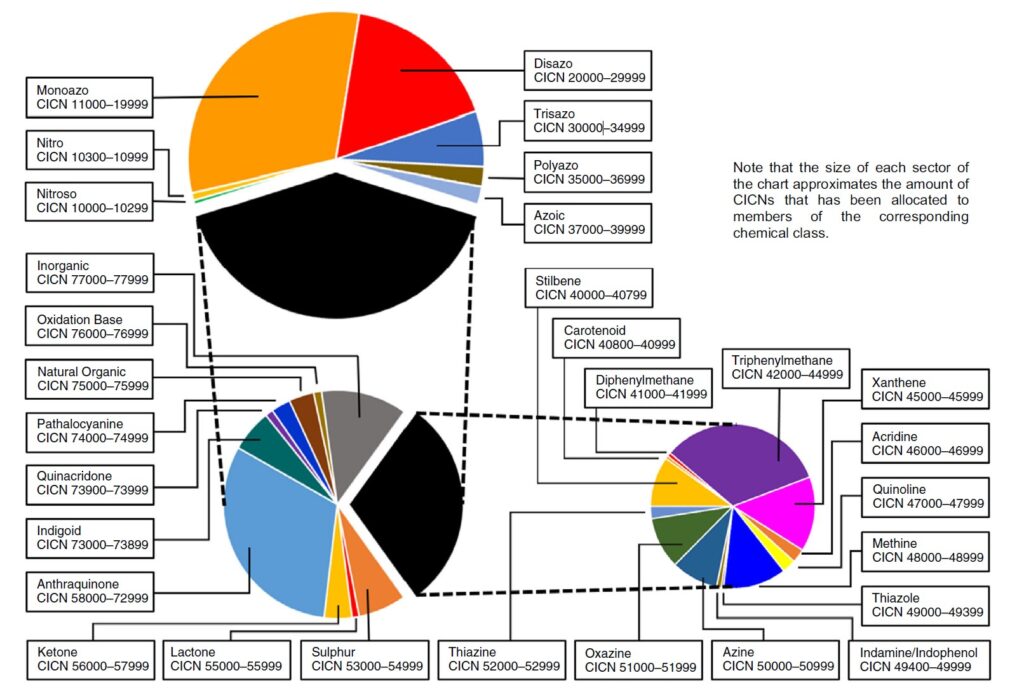
Practical insights into using the Colour Index™
Within the current online Fourth Edition (Colour Index International Online), entries are presented as “Fingerprint” pages. These bring together the essential identifiers and technical data for each colorant, including the C.I. Generic Name (CIGN), C.I. Constitution Number (CICN), chemical structure and class, as well as information on shade, discoverer, and first known product. Registry identifiers—such as CAS and EU numbers—and historical or classical names are also included where relevant. This core entry is followed by commercial information, listing product names, manufacturers, physical form, and primary applications, along with any additional details provided by producers. In this sense, each entry connects chemical identity with real-world materials.
Reading pigment codes: For most users, the most visible part of the system is the C.I. Generic Name, commonly found on paint labels. These codes follow a simple structure:
- Letters indicate the pigment group (e.g. PB = Pigment Blue)
- Numbers identify the specific pigment
So, for example, PB29 – C.I. Pigment Blue 29 refers to Ultramarine Blue, regardless of brand or marketing name. This is where the system becomes particularly useful: paint names are not standardized, but pigment codes are. A single pigment may be sold under many different names—for example, Phthalocyanine Green may also appear as Brilliant Green, Cyan Green, Monestial Green, or Emerald Green Substitute, all referring to Pigment Green 7. At the same time, paints that share the same name can actually be made from completely different pigments. The CI code provides a stable reference point.
Common prefixes include:
- PW → White
- PY → Yellow
- PO → Orange
- PR → Red
- PV → Violet
- PB → Blue
- PG → Green
- PBr → Brown
- PBk → Black
However, not all colorants follow the standard “P” (pigment) classification. Some natural colorants use an “N” prefix, indicating their natural origin (e.g. NY6 – C.I. Natural Yellow 6 = Saffron).
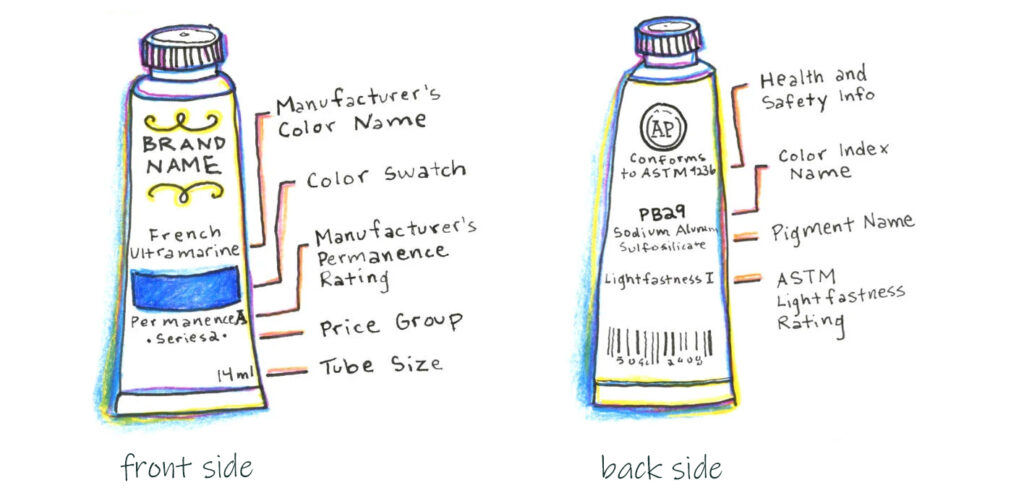
Reading mixtures and variations: Many paints are composed of multiple pigments, not just one. When listed, these pigments appear in order of proportion—from highest to lowest—similar to ingredient labels on food or cosmetics. This can offer valuable insight into how a color will behave in mixing or layering.
At the same time, pigments can vary in tone and handling depending on production, and therefore, some codes cover a range of natural variations. For example, PBr7 – C.I. Pigment Brown 7 (natural iron oxide), covers Raw Sienna, Burnt Sienna, Raw Umber, and Burnt Umber—all visually different, but chemically related.
Limits of the system: Despite its scope, the Colour Index™ is not exhaustive. Some historic or rare pigments do not have official CI classifications codes (e.g. Aerinite, Egyptian Mummy, etc). These materials fall outside the standardized system and must be approached through other sources.
Searching by Colour Index™ codes in INFRA-ART
Once understood, the Colour Index™ becomes a powerful way to navigate pigment information across sources.
In the INFRA-ART database, for example, you can search pigments directly by their CIGN code using the Advanced Search tool:
- search directly by a code (e.g. enter a code like “PB29” or “C.I. Pigment Blue 29” in the Alternative Name field to find a specific pigment
- or enter “Pigment Blue” in the same field to browse the full category
- explore natural colorants using terms like “Natural Red“ or specific identifiers (e.g. NR4)
Rather than relying on names alone, the system allows you to move between materials, datasets, and products with greater precision and consistency.

Further reading and resources
Abel A. (2024) Happy 100 year anniversary of the International Colour
Index. The Colourist, 6-9. https://sdc.org.uk/wp-content/uploads/2024/03/5851-The-Colourist-March-2024-V4-4.pdf
Burdett, B.C. (1982). The Colour Index: The Past, Present and Future of Colorant Classification. Journal of the Society of Dyers and Colourists, 98(4): 114-120. https://doi.org/10.1111/j.1478-4408.1982.tb03625.x
Clark, M. (2021) Dyeing for a Living: A History of the American Association of the Textile Chemists and Colorists: 1921-1996. American Association of Textile Chemists and Colorists.
Colour Index™ 2.0. https://colour-index.com
Color of Art Pigment Database. https://www.artiscreation.com/Color_index_names.html
Hallas, G. (2023). Colour Index. In: Shamey, R. (eds) Encyclopedia of Color Science and Technology. Springer, Cham. https://doi.org/10.1007/978-3-030-89862-5_443
Hatch, E. (2021, September 6) What is the Pigment Colour Index? Jackson’s Blog. https://www.jacksonsart.com/blog/2021/09/06/everything-you-need-to-know-about-the-pigment-colour-index/
Orna, M.V. (2013) The Chemical History of Color. Springer.
Towns, A. (2025) Chemical constitutions in the Colour Index™: A century of colourant classification. Coloration Technology, 141(4): 427-472. https://doi.org/10.1111/cote.12819

How to cite this resource
Cortea, I.M. (2026, April 20). A guide to the pigment Colour Index™: history and practical insights. INFRA-ART Blog. https://blog.infraart.inoe.ro/2026/04/20/a-guide-to-the-pigment-colour-index-history-and-practical-insights/