

by Ioana Maria Cortea — Published on July 20, 2026 — Reading time: 7 min
Article sections
» Advanced search: multi-criteria querying for targeted discovery » FTIR peak search: spectral feature-based querying » XRF elemental search: elemental composition-based querying » Responding to user needs: rationale and timing » A distinctive approach: curated data at the core » Future developments and community input
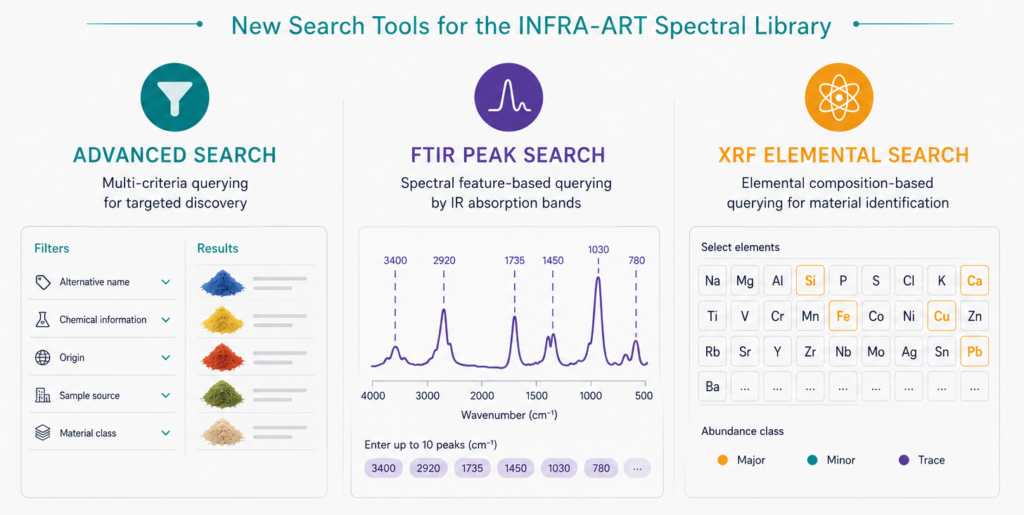
Over the past year, the INFRA-ART Spectral Library has evolved from a specialized institutional data repository into a more mature, EOSC-aligned data service. Alongside infrastructure upgrades, one of our key priorities has been improving how users discover, explore, and interact with the growing collection of samples and analytical datasets available within the INFRA-ART platform.
With the latest developments, we introduce a new generation of search tools designed to support more targeted and scientifically meaningful queries across the database: → an advanced search tool for multi-criteria filtering; → an FTIR peak search tool enabling spectral querying by IR absorption bands; → and an XRF elemental search tool supporting material identification via elemental composition.
Together, these tools represent an important step toward analysis-driven data exploration and reflect a shift in how users engage with the INFRA-ART platform—from browsing and keyword search to multi-parameter querying, spectral feature matching, and composition-based exploration. The aim of these developments was to move beyond basic access toward a more refined, analysis-oriented user experience.
Discover how these tools work—and how they were designed to support real research workflows—in the sections below.
Advanced search: multi-criteria querying for targeted discovery
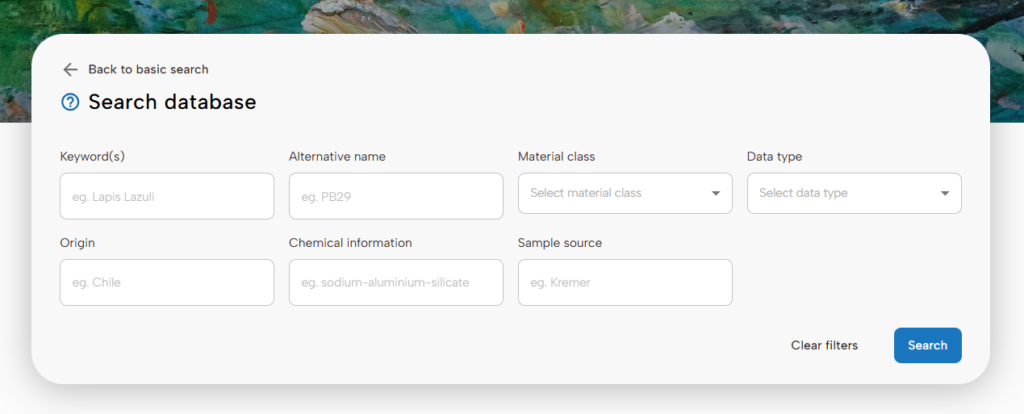
The newly introduced advanced search tool responds to a simple but critical need: enabling users to move beyond basic keyword queries and perform targeted, multi-filter searches across the database. This tool allows users to: → combine multiple criteria within a single query → select only the fields relevant to their research → retrieve results that match all selected conditions.
In practice, this means users can now construct queries such as:
- samples with known chemical composition
- datasets associated with a particular origin or source
- materials from a specific producer
- materials in a specific subclass
This approach significantly reduces time spent navigating the database and supports more efficient research workflows, particularly for users working with large or highly specific datasets.
FTIR peak search: spectral feature-based querying
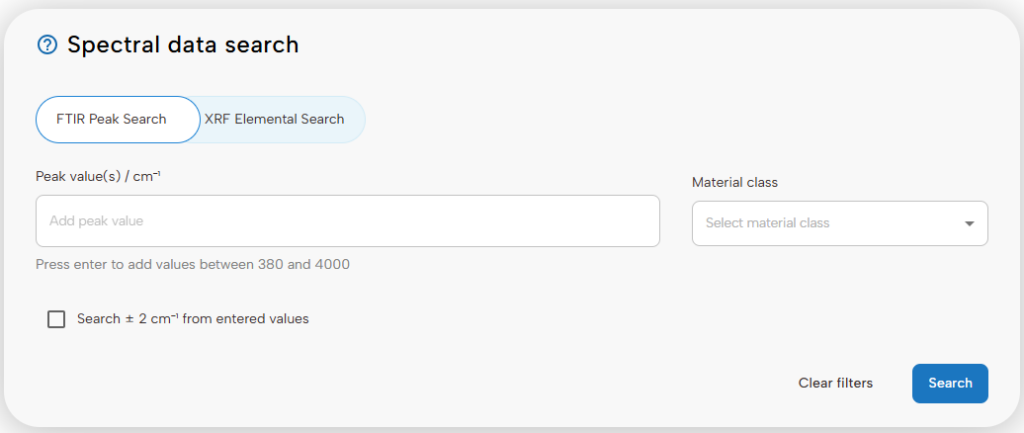
Responding to strong community interest, the FTIR peak search tool introduces a new way to interact with spectral data by enabling direct searches based on infrared absorption peaks. Infrared absorption bands function as a spectral fingerprint, carrying chemical information that enables differentiation between similar materials and supports robust identification in complex contexts. This feature allows users to identify samples with matching spectral characteristics.
How it works: Users can search for samples by entering up to 10 peak values (in cm⁻¹), with a configurable tolerance of ±2 cm⁻¹. The search engine: → matches samples containing the selected peaks → returns results that satisfy the full peak query → allows further refinement through filters such as material class.
This enables workflows such as:
- identifying unknown materials based on diagnostic peaks
- comparing spectra across different sample groups
- narrowing down candidates prior to detailed analysis
Design approach: A key design decision was to prioritize robust results. Currently, all peaks are treated with equal weight, and emphasis is placed on strong to medium, sharp diagnostic bands; weak peaks, shoulders, and problematic spectral regions are excluded. This ensures that the search results are driven by clear, reproducible spectral features. While more complex weighting or pattern recognition approaches could be introduced in the future, the current implementation focuses on clarity, transparency, and usability.
XRF elemental search: elemental composition-based querying
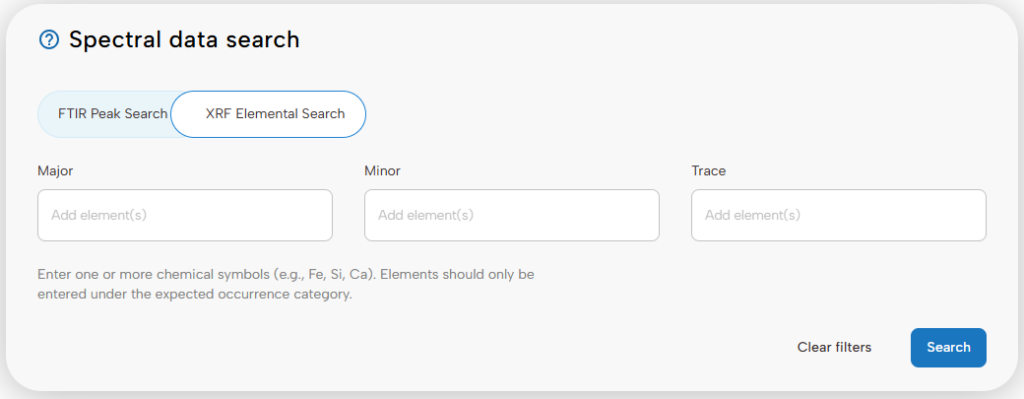
Complementing FTIR-based querying, the XRF elemental search tool enables users to explore the database based on elemental composition derived from XRF analysis. This tool supports elemental characterization workflows, particularly in the study of inorganic materials and complex compositions where elemental distribution plays a key role in identification.
Users can: → select one or multiple chemical elements → filter results using predefined semi-quantitative classifications (major, minor, or trace elements) → retrieve samples whose XRF spectra match the selected criteria (exact match).
This tool is particularly useful for:
- identifying materials based on elemental signatures
- comparing materials with similar compositions
- supporting preliminary classification in analytical workflows
- narrowing down candidates prior to complementary analyses
All elemental data are manually curated, ensuring significantly higher accuracy and interpretability compared to automated detection methods. Together with FTIR peak search, this tool strengthens INFRA-ART’s ability to support data-driven material identification.
Responding to user needs: rationale and timing
The development of dedicated FTIR and XRF search tools is closely aligned with both the structure of the database and the needs of the user community.
Currently:
- FTIR and XRF datasets represent the largest and most frequently accessed collections within the INFRA-ART spectral library
- both techniques are among the most widely used analytical methods in heritage science
- their popularity is driven by accessibility, affordability, and especially their non- or minimally invasive nature, both in laboratory and in-situ
In this context, developing specialized search tools for these datasets directly addresses real user needs and significantly enhances the (re)usability of spectral data. At the same time, the growing volume of data within the INFRA-ART database has made advanced filtering and segmentation mechanisms essential.
A distinctive approach: curated data at the core
The spectral search tools are built on expert-curated data, rather than relying exclusively on automated detection. This approach: → ensures a high level of accuracy and trustworthiness; → improves the quality and relevance of search results; → avoids the limitations and interpretability issues associated with fully automated methods.
The integration of human expertise into the search engine architecture is a key factor underpinning the robustness of the INFRA-ART platform and a defining feature of the service. The coverage of curated spectral analytical data is continuously expanding. Currently, curated FTIR peak values are available for the complete collection of reference material FTIR spectra, while curated XRF elemental data are available for approximately 30% of the reference datasets.
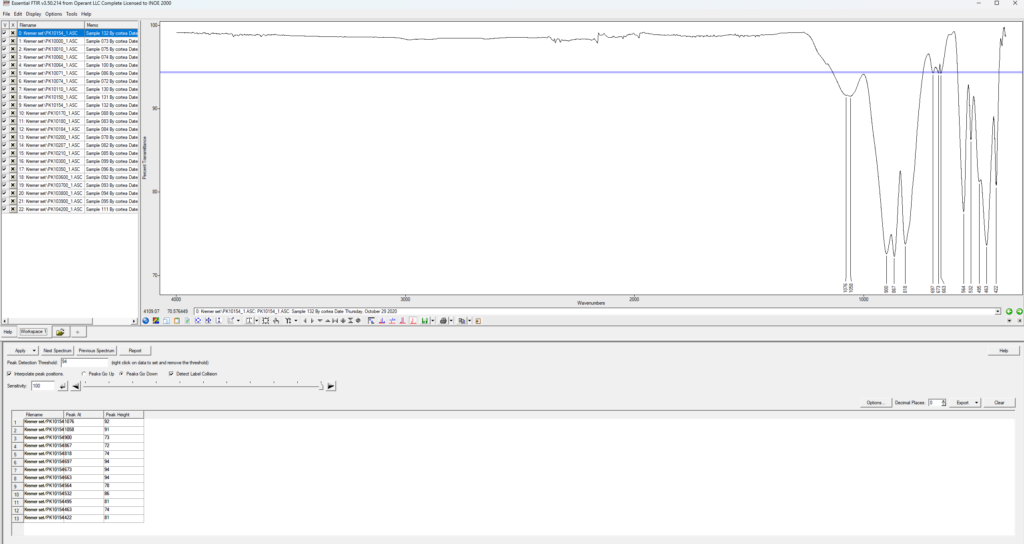
This approach reflects an ongoing effort: building high-quality metadata for spectral datasets is a time-intensive process that requires sustained expert input, careful validation, and consistent methodological decisions. Unlike automated approaches, which may introduce inconsistencies or misinterpretations, curated data ensure that the identified spectral features are accurately represented and remain scientifically meaningful.
This investment of time is essential for enabling reliable, interpretable, and analytically robust search functionalities. It not only improves the precision of search results, but also enhances their scientific value, allowing users to confidently compare datasets, identify materials, and draw informed conclusions. In this context, (meta)data curation is a fundamental component of the search functionality itself, directly shaping the quality, relevance, and usability of the results returned to the user.
Future developments and community input
At present, such analytical search tools remain rare within open-access research data infrastructures. To our knowledge, at this moment no other platforms offer comparable search functionalities tailored to the specific needs of heritage science and spectral data users. Their relevance and usefulness have already been confirmed through user feedback and direct interactions with the community, highlighting both their innovative character and practical value.
These tools represent an important step—but not the final one. Future developments will continue to expand data coverage, refine search capabilities, and further align the platform with real research workflows.
We invite the INFRA-ART user community to explore the new search tools and share their feedback 📩 info@infra-art.eu. Community insights are essential for improving the usability, and overall performance of these tools, and for shaping the next stage of development.

How to cite this resource
Cortea, I.M. (2026, July 20). Expanding data discovery in INFRA-ART: introducing new and enhanced search tools. INFRA-ART Blog. https://blog.infraart.inoe.ro/2026/07/20/expanding-data-discovery-in-infra-art-introducing-new-and-enhanced-search-tools