

by Ioana Maria Cortea — Published on February 4, 2026 — Reading time: 7 min

Part of the INFRA-ART FAIR Journey article series
Article sections

We are pleased to announce the relaunch of the INFRA-ART platform – a major milestone marked by the transition to a new, fully EOSC-aligned architecture. This release represents a fundamental technological upgrade of the INFRA-ART Spectral Library data service, designed to meet current European standards for open and interoperable research infrastructures. As part of this evolution, the INFRA-ART Spectral Library has also moved to a new domain: infra-art.eu.
Developed within the framework of the OPEN-SciART project, and in collaboration with Evozon – our new technological partner, the upgraded platform introduces a modern backend–API–frontend separation that enables advanced interoperability, an enhanced user experience, and long-term scalability, while strengthening INFRA-ART’s commitment to the FAIR and TRUST principles. In the sections below, we outline the main reasons behind this redesign, explain how the new platform aligns with EOSC and FAIR principles, present the updated system architecture, and highlight key user experience improvements and upcoming developments.
Why a new architecture was needed
Since its initial launch in 2021, INFRA-ART has grown into a widely used open-access FAIR data service dedicated to heritage science and related interdisciplinary fields. The continuous expansion of the database, the increasing diversity of spectral techniques, and the growth of an international user community – along with its evolving needs – have significantly raised both technical and functional requirements.
Based on feedback received from our users, it became clear that researchers expect more than simple data access. They rely on advanced discovery tools, standardized and high-quality metadata, automated interoperability with other infrastructures, and guarantees of long-term data availability and reuse. At the same time, European research policy increasingly emphasizes the adoption of FAIR principles and technical alignment with the European Open Science Cloud Interoperability Framework – EOSC IF.
To accommodate these developments, it became clear that incremental updates to the existing system would no longer be sufficient. Instead, a complete architectural redesign was required to support INFRA-ART’s future role as a sustainable, trustworthy, and interoperable research infrastructure.
EOSC alignment and FAIR by design
The decision to rebuild the platform was driven not only by technical considerations, but also by short- and long-term strategic objectives. These include aligning INFRA-ART with the EOSC IF, embedding the FAIR and TRUST principles at both data and service level, following European recommendations for the operational implementation of open science practices, and consolidating the platform as a modern, sustainable, and internationally competitive research infrastructure. Together, these developments lay the foundation for future CoreTrustSeal certification, strengthening INFRA-ART’s mission and values while reinforcing its role as a sustainable and trustworthy data service.
Overview of the new platform architecture
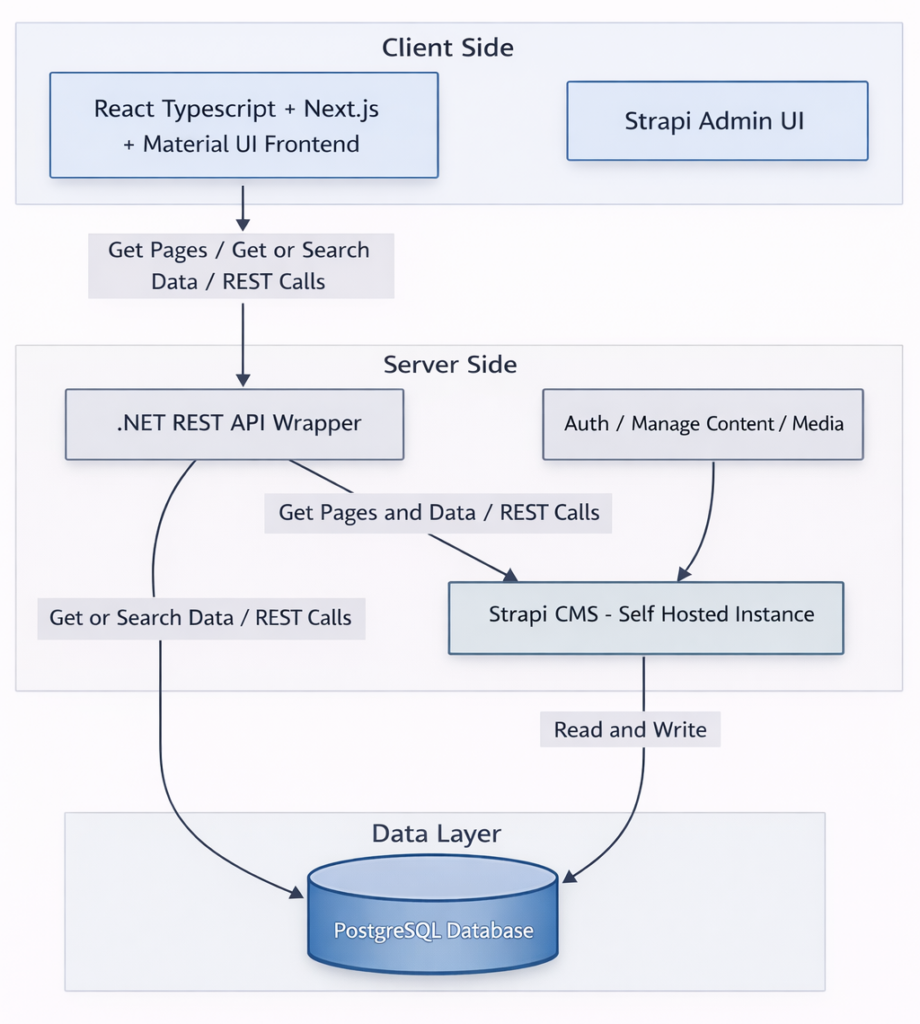
At the core of the relaunch lies a complete architectural redesign. The previous application has been replaced with a modular system built around a dedicated REST API. This separation between data services, user interface, and content management enables greater flexibility, improved performance, easier long-term maintenance, and lower hosting and operational costs over time.
The new platform combines:
- a modern frontend developed with Next.js and React,
- a .NET 8 backend API handling data access and business logic,
- a dedicated content management system (Strapi) for non-technical admins,
- and a PostgreSQL database optimized for large-scale scientific datasets.
The entire infrastructure is hosted on European servers provided by Hetzner, compliant with ISO 27001 security standards and GDPR requirements. Beyond the technical stack, the modernization also introduced mature software development practices, including structured versioning and branching strategies, standardized code reviews, and automated testing.
| Layer | Technology | Purpose / Role |
|---|---|---|
| Frontend | Next.js (React + TypeScript) | Modern, component-based user interface; consumes REST API |
| Frontend | Material UI | Design system and reusable components for a consistent user experience |
| Backend API | .NET 8 REST API | Business logic (file processing, search), validation, EOSC and OpenAIRE compliance |
| CMS | Strapi (self-hosted) | Content management and administration interface |
| Database | PostgreSQL | Main data storage for spectral datasets and CMS content |
| Hosting | Hetzner | Deployment and hosting of API, CMS, and frontend |
| Testing (Backend) | XUnit | Unit testing for complex backend services |
| Monitoring | Google Analytics (TBD) | System metrics and availability monitoring |
The new system fully complies with the technical interoperability requirements of the EOSC IF, preparing the platform for automated indexing and seamless integration into the European research data ecosystem. Compared to the previous architecture, the new API-based design enables standardized exposure of metadata in machine-actionable JSON formats, supports automated data delivery and exchange workflows, facilitates integration with international aggregators and registries, and provides significantly greater flexibility for future technical development and functional expansion.
The technical redesign of the platform was carried out in close collaboration with Evozon, a software engineering company with over 20 years of experience in delivering complex digital solutions. Based in Cluj-Napoca, one of Romania’s leading technology and innovation hubs, Evozon works across academic, public, and private sectors to design, build, and operate robust digital platforms and solutions. This partnership ensured that the new INFRA-ART platform follows current best practices in software engineering, including modular design, automated testing, structured version control workflows, and performance optimization.
An enhanced user experience
While the architectural transformation is largely invisible to end users, its impact is reflected in the new interface and workflows. The frontend has been rebuilt following modern UX and accessibility standards, offering faster page loading through server-side rendering, improved navigation across collections and tools, and consistent visual design across the platform. The layout adapts to different devices and supports more complex interactions with large datasets.
For non-technical editors and administrators, the integration of Strapi represents one of the most practical improvements. The CMS allows intuitive management of pages, components, and narrative content, and is directly connected to the API, enabling automatic synchronization and a much smoother editorial workflow.
User feedback and next steps
We invite the community to explore the new INFRA-ART platform, test its features, and share feedback on both the interface and the underlying services. Insights from researchers, conservators, data specialists, students and educators play a key role in guiding future development and in ensuring that the platform continues to address real research needs and everyday analytical workflows.
While this relaunch marks the completion of a major development phase, it also opens the door to the next stage. Several new releases are already planned for 2026, including the expansion of online analytical tools, further improvements to data discovery and interoperability, and the integration of new spectral datasets – including new data types.
Your experience matters to us. Share your thoughts, questions, or suggestions at infraart@inoe.ro or via our user feedback survey.

Further reading and resources
Cortea, I.M. (2025). Developing an interoperability policy roadmap for the INFRA-ART Spectral Library at the National Institute for Research and Development in Optoelectronics. Zenodo. https://doi.org/10.5281/zenodo.15784837
Cortea, I.M. (2025). Interoperability Policy Roadmap for the INFRA-ART Spectral Library. Zenodo. https://doi.org/10.5281/zenodo.15681804
Cortea, I. M. (2025). TRUST Principles Use Case. Zenodo. https://doi.org/10.5281/zenodo.17060690
European Commission: Directorate-General for Research and Innovation, EOSC Executive Board, Corcho, O., Eriksson, M., Kurowski, K. et al., EOSC interoperability framework – Report from the EOSC Executive Board Working Groups FAIR and Architecture, Publications Office, 2021. https://data.europa.eu/doi/10.2777/620649
Scardaci, D.O., et al. (2023). A landscape overview of the EOSC Interoperability Framework – Capabilities and Gaps (Version 1). Zenodo. https://doi.org/10.5281/zenodo.8399710

How to cite this resource
Cortea, I.M. (2026). INFRA-ART platform relaunch: building an EOSC-compliant infrastructure for FAIR spectral data. INFRA-ART Blog