
by Ioana Maria Cortea — Published on January 19, 2026 — Reading time: 7 min
Part of the INFRA-ART FAIR Journey article series
Article sections

Since the implementation of Google Analytics in October 2022, the INFRA-ART Spectral Library has steadily grown into a widely used international data service supporting research, education, and conservation activities across the globe. What began as a specialized technical platform has evolved into a shared resource for a diverse and expanding community of users. With usage expanding across continents and disciplines, the project is now entering a new phase of visibility, usability, and collaboration, shaped increasingly by its user community.
In the sections that follow, we present an overview of INFRA-ART’s usage statistics from 2022 to 2025, including global access patterns, user growth trends, and the most active research communities. We also highlight how users discover the platform, what types of data attract the most interest, and how improvements in FAIR-aligned metadata have influenced visibility and engagement.
Overall platform statistics
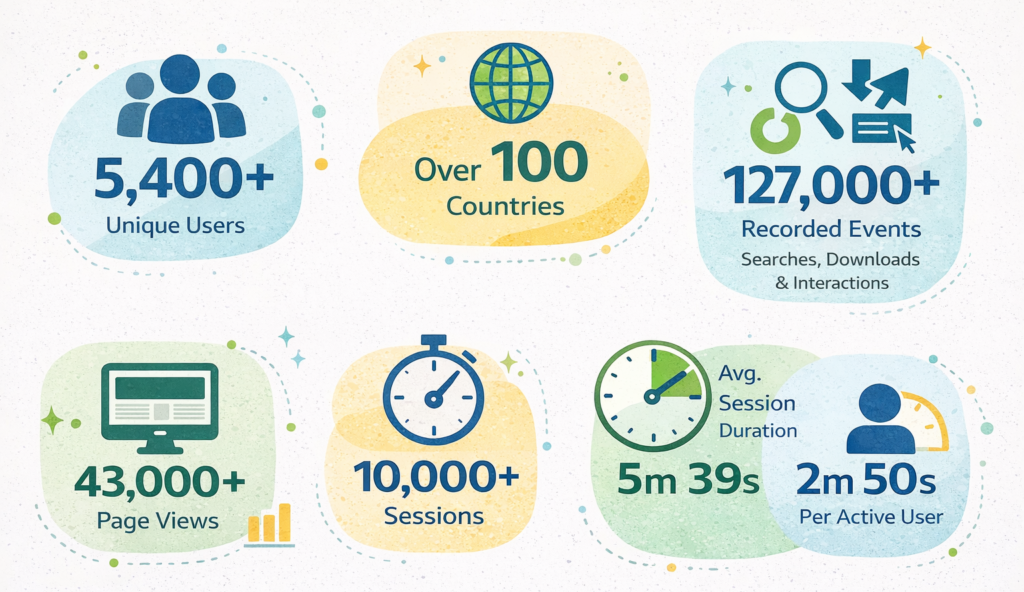
Between October 2022 and December 2025, the INFRA-ART Spectral Library recorded:
- more than 5,400 unique users from over 100 countries
- 43,000+ page views
- 127,000+ recorded events (searches, downloads, and interactions)
- 10,000+ sessions
- an average session duration of 5 minutes 39 seconds
- an average engagement time per active user of 2 minutes 50 seconds
Beyond the numbers, engagement metrics suggest that users are not merely landing on the site and leaving; they are actively exploring datasets, refining searches, and interacting with the platform in ways that reflect sustained research and professional use. Approximately 20% of global users are returning visitors, indicating that many have integrated the platform into their regular workflows. After two years of relatively stable usage at about 1,500 users annually, the platform experienced a notable increase in 2025, reaching over 2,300 users. This growth was largely driven by significant improvements in the machine-actionability and semantic quality of the metadata, as discussed later in this article.
Geographic distribution of users
To date, users from 106 countries have accessed the INFRA-ART platform. The top 20 countries by number of unique active users are:
| Rank | Country | Unique active users | % of total |
|---|---|---|---|
| 🥇 1 | 🇨🇳 China | 1,031 | 19.00 |
| 🥈 2 | 🇺🇸 United States | 632 | 11.67 |
| 🥉 3 | 🇮🇹 Italy | 394 | 7.27 |
| 4 | 🇷🇴 Romania | 366 | 6.76 |
| 5 | 🇸🇬 Singapore | 273 | 5.04 |
| 6 | 🇬🇧 United Kingdom | 223 | 4.12 |
| 7 | 🇪🇸 Spain | 181 | 3.34 |
| 8 | 🇩🇪 Germany | 176 | 3.25 |
| 9 | 🇫🇷 France | 161 | 2.97 |
| 10 | 🇳🇱 Netherlands | 139 | 2.57 |
| 11 | 🇵🇹 Portugal | 134 | 2.47 |
| 12 | 🇮🇳 India | 133 | 2.46 |
| 13 | 🇬🇷 Greece | 129 | 2.38 |
| 14 | 🇧🇷 Brazil | 119 | 2.20 |
| 15 | 🇵🇱 Poland | 105 | 1.94 |
| 16 | 🇷🇺 Russia | 88 | 1.62 |
| 17 | 🇮🇪 Ireland | 87 | 1.61 |
| 18 | 🇨🇦 Canada | 76 | 1.40 |
| 19 | 🇯🇵 Japan | 72 | 1.33 |
| 20 | 🇲🇽 Mexico | 65 | 1.20 |
This global distribution highlights the platform’s relevance across research groups, cultural heritage institutions, universities, and laboratories operating in very different contexts but sharing similar analytical needs.
Throughout the monitoring period, the United States and China have consistently emerged as the most active user communities. Their sustained engagement reflects broader global research dynamics and the increasing role of spectral analysis in both heritage science and materials research. At the same time, in the last year, traffic has been steadily increasing in Latin America and South-East Asia, pointing to growing international visibility beyond Europe and North America.
How users discover INFRA-ART
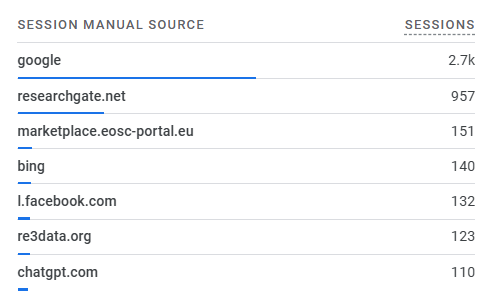
Most new users discover the platform through direct access, followed by organic search engines, academic platforms and referrals, and, increasingly, AI-assisted tools. This growth is closely linked to: strong indexing in scholarly and technical search engines, and inclusion in international open science catalogues and research data repositories such re3data, FAIRsharing or OpenDOAR. Among referral sources, Google Search remains dominant, but in the past year ChatGPT has entered the top three traffic sources, highlighting the growing role of AI tools in how researchers discover scientific resources.
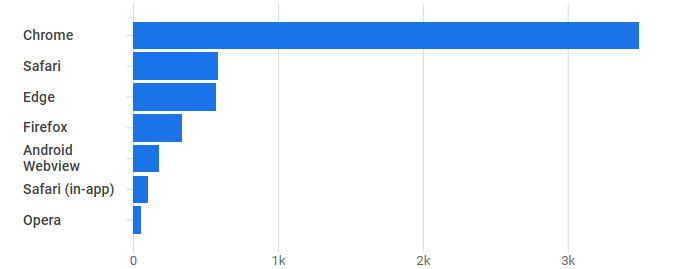
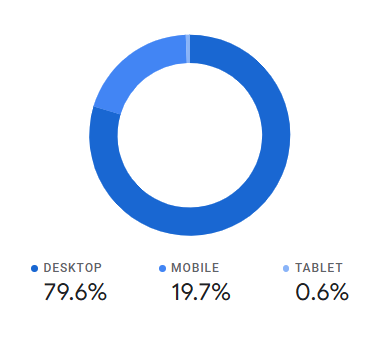
In terms of technical usage most visitors use desktop devices (80%), about 20% access the platform from mobile devices, and Chrome is by far the most common browser.
Dataset-level access: what users search for
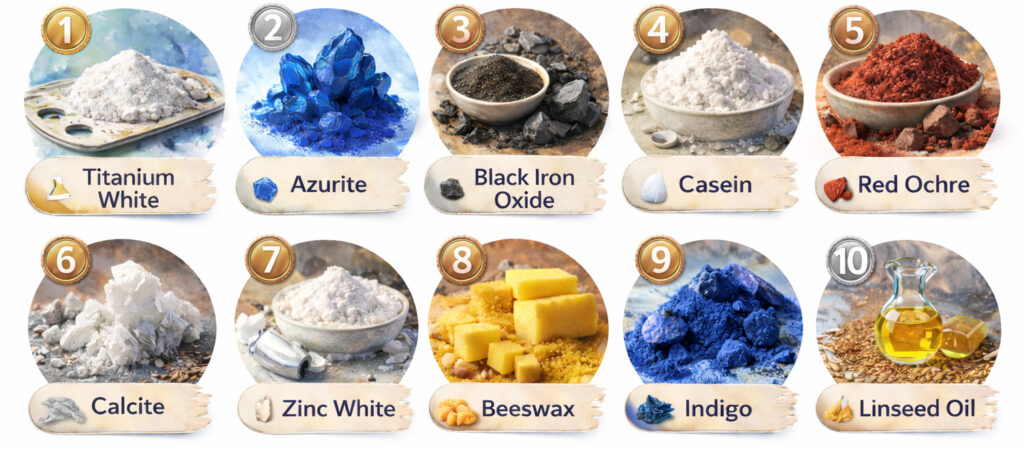
Looking at database queries also offers insight into how the platform is used. The most frequently searched materials (top 20 searches) include: Titanium White, Azurite, Black Iron Oxide, Casein, Red Ochre, Calcite, Zinc White, Beeswax, Indigo, Linseed Oil, Chrome Yellow, Lamp Black, Cinnabar/Vermilion, Alizarin, Malachite, Prussian Blue, Rabbit Skin Glue, Gum Arabic, Smalt, and Dammar. This pattern reflects a sustained interest in historical pigments, organic binders, and traditional artistic materials in general. Since these materials are commonly encountered in artworks and cultural heritage objects, their prominence in user searches is not surprising. The concentration of queries around them also suggests that the platform is being actively integrated into everyday analytical workflows, providing clear confirmation of INFRA-ART’s role as a reference resource for heritage science, conservation research, and technical art history.
Recent activity: a closer look at the past year
In 2025 alone, the platform welcomed more than 2,300 unique users, generated over 21,000 page views, and recorded approximately 61,000 interaction events — from dataset searches and filtering to metadata exploration and downloads.
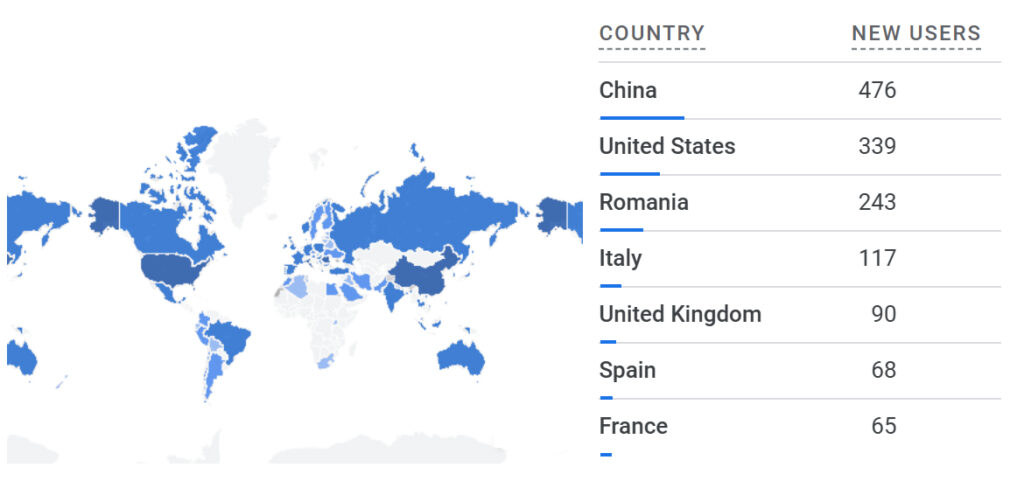
The most active user communities during this period were based in China, the United States, Romania, Italy, the United Kingdom, Spain, and France. Notably, user activity from Asia showed one of the strongest year-on-year increases, representing a major growth area for INFRA-ART in 2025 and highlighting the platform’s expanding visibility across the region.
Nearly 60% of all visits within the last year came from direct access, followed by organic search (around 30%), with the remaining share divided between social media and academic referral sources. This pattern suggests that many users now reach INFRA-ART deliberately — either returning to a familiar resource or discovering it through targeted scholarly queries.
An analysis of this year’s search statistics indicates that linseed oil, bone black, and gesso ranked among the most frequently queried materials. This finding suggests that, beyond pigments, organic binders and mineral fillers (commonly found in ground layers) are also a key focus for users, reinforcing the strong and sustained demand for reference data on traditional historical materials.
How FAIR metadata drove platform growth
Improving the machine-actionability of INFRA-ART’s datasets became a central objective during the platform’s development over the past year. This was achieved through a semantic upgrade of the metadata framework applied to both repository-level descriptors (carried out as part of a FAIR-IMPACT support action) and dataset-level descriptors (supported through the FAIRMap4ART RDA TIGER project).
By improving standardization, interoperability, and machine actionability, these changes made datasets easier to index, and retrieve across digital infrastructures. The effect of these semantic improvements was both rapid and measurable. Following the metadata upgrades, the platform recorded a 70%+ increase in new users within a single year. This growth highlights the direct link between machine-actionable, well-structured metadata and discoverability. It confirms in practice that FAIR-aligned metadata is not just a technical detail, but a strategic foundation for visibility, data reuse, and long-term scientific impact.
From access to impact: data reuse in practice
Usage statistics tell only part of the story; the true value of the INFRA-ART Spectral Library data service lies in how its datasets are accessed and reused. Since its launch, based on feedback from our users, INFRA-ART spectral data have supported peer-reviewed scientific publications, university teaching and student projects, conservation and restoration workflows, and interdisciplinary collaborations bridging the natural sciences and the humanities.
To date, 16 institutions or research teams have requested file-level access, and the database has been cited in 18 scientific peer-reviewed publications (excluding self-citations), primarily within heritage science and related interdisciplinary fields. User feedback further indicates reuse in cross-disciplinary domains, including machine-learning applications and advanced optical materials research. A curated overview of documented reuse cases and publications is available at: https://infraart.inoe.ro/data_reuse_cases. Further insights and a more critical analysis of these reuse patterns will be presented in an upcoming article.

How to cite this resource
Cortea, I.M. (2026). FAIR data, global impact: what three years of INFRA-ART usage reveal. INFRA-ART Blog