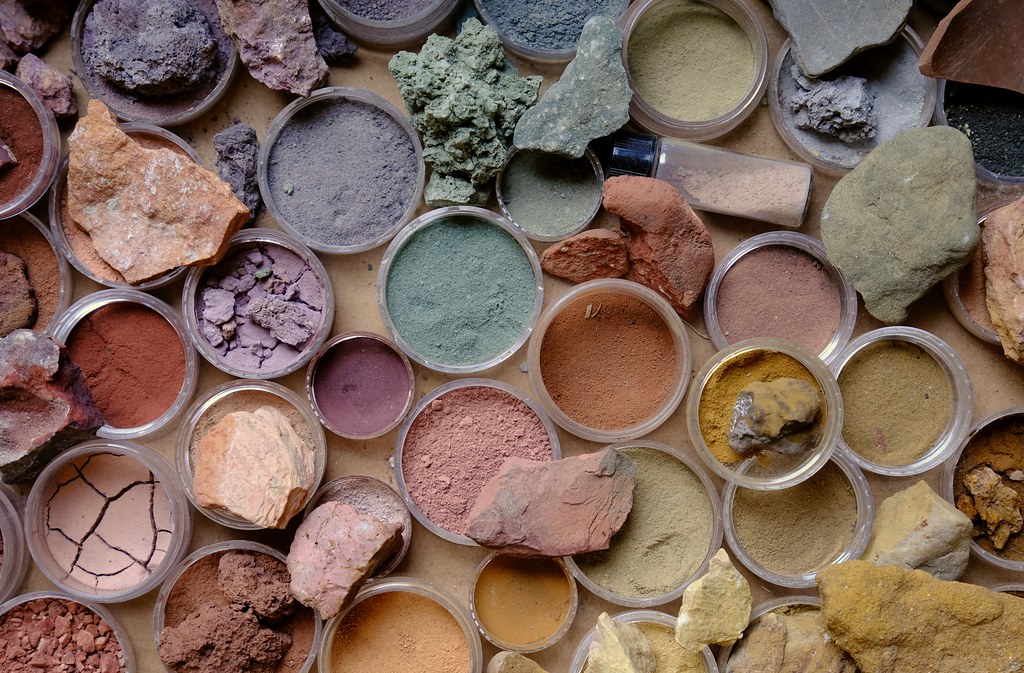
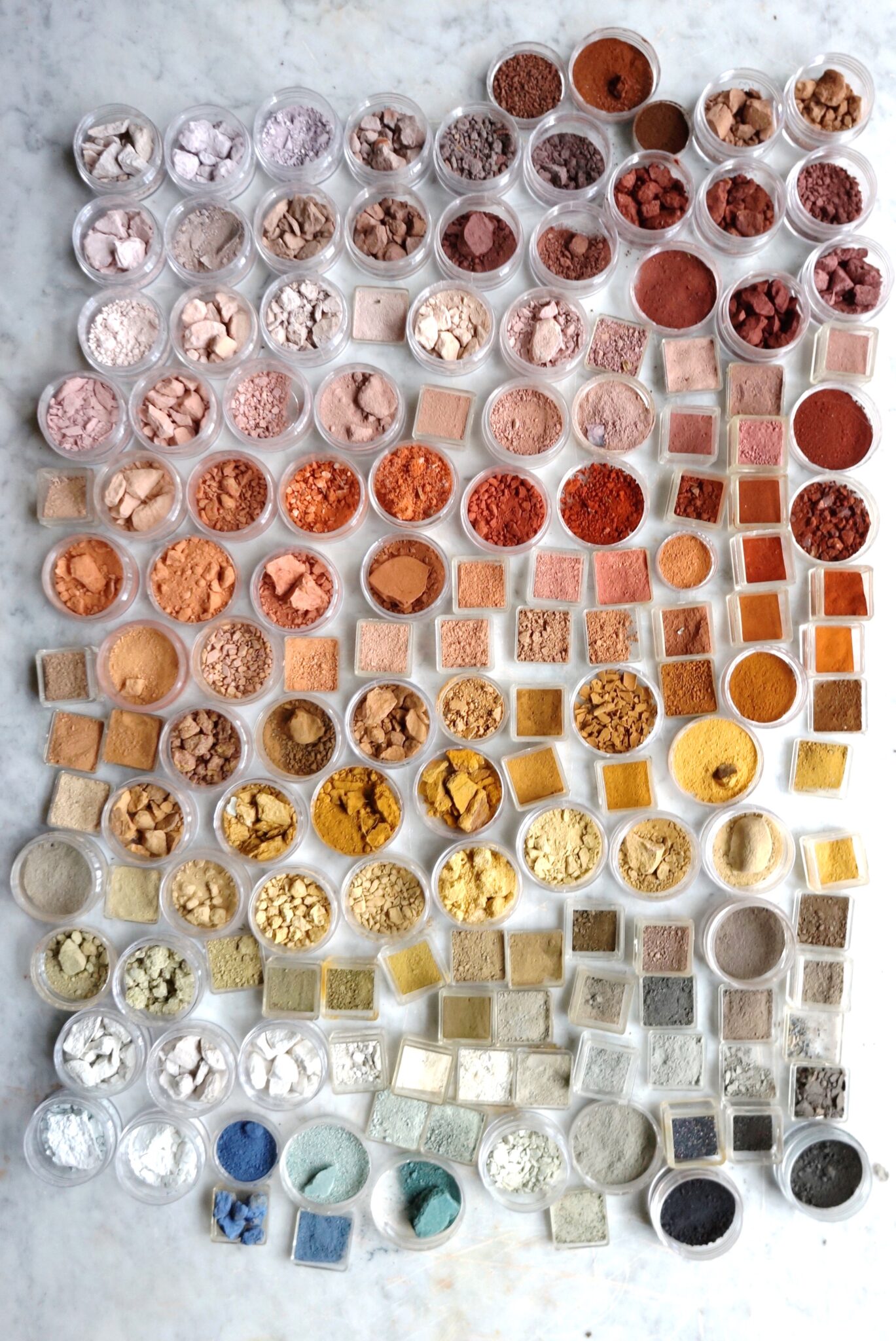
Earth pigments are among the oldest materials used in human artistic expression. These naturally occurring pigments, derived from iron oxides, manganese compounds, clays, and other minerals, have been used since the earliest symbolic expressions of humanity and remain vital in both artistic and conservation practices today. Valued for their sustainability and safety, earth pigments are widely used in natural paints and are regaining popularity in contemporary eco-conscious art practices. More importantly, they are archaeological markers — remnants of color choices made by ancient societies that can tell us about trade routes, resource availability, and artistic conventions. The mineralogical and geochemical fingerprints of earth pigments, often highly complex, can be matched to known geological sources, providing valuable evidence for provenance studies.
In this post, we examine the mineralogy, classification, and nomenclature of earth pigments, explore their historical applications across cultures, and introduce the collections of earth pigments currently represented in the INFRA-ART spectral database.
Earth pigments: key technical characteristics
Composition and classification of earth pigments: Earth pigments encompass a broad range of naturally occurring mineral mixtures, typically categorized into groups such as iron-rich ochres, manganese-rich wads, umbers, green earths, white earths (including chalk, kaolinite, and diatomite), organic-rich materials like coal and other solid hydrocarbons, and vivianite-bearing blue earths.
The chemistry of earth pigments is inherently complex, shaped by the environmental conditions under which they formed. They typically consist of several chromophore minerals—primarily iron and manganese oxides or hydroxides—alongside a variety of accessory minerals. These accessory phases may include clays, quartz, carbonates (such as calcite or dolomite), and other minor and trace mineral components. The genetic environment also influences key properties of iron oxide minerals, including their hydration state, structural order, and crystal size. Together, these factors determine a pigment’s color, texture, opacity, and binding behavior.
Group
Alternative names
Color
Main coloring components
Ochres
ochre, flesh ochres, variations given by the geographical location of the source (e.g., Bristol ochre)
varying from browns and reds through yellows
iron oxide- and hydroxide-rich earths
Siennas
terre de Sienne, terra di Siena, Siena-erde
yellow-brown
iron hydroxide-rich earths + minor amounts of manganese oxides (<5%)
Umbers
ombra, terre d’ombre, terra d’ombra, tierra de sombra
warm brown to greenish brown
iron oxides + manganese oxides (between 5 and 20%)
Wads
bog manganese, black wad, black earth, manganese ochres
dark brown to black
iron oxides + manganese oxides (c. 50%)
Green earths
terra verde, terre vert, green stone
green to bluish green
clay minerals, celadonite or glauconite
Humic earths
Cassel earth, Cologne earth, Vandyke brown
rich brown
low-grade coal deposits or lignites
Main groups of earth pigments and their principal characteristics. Source: MDPI
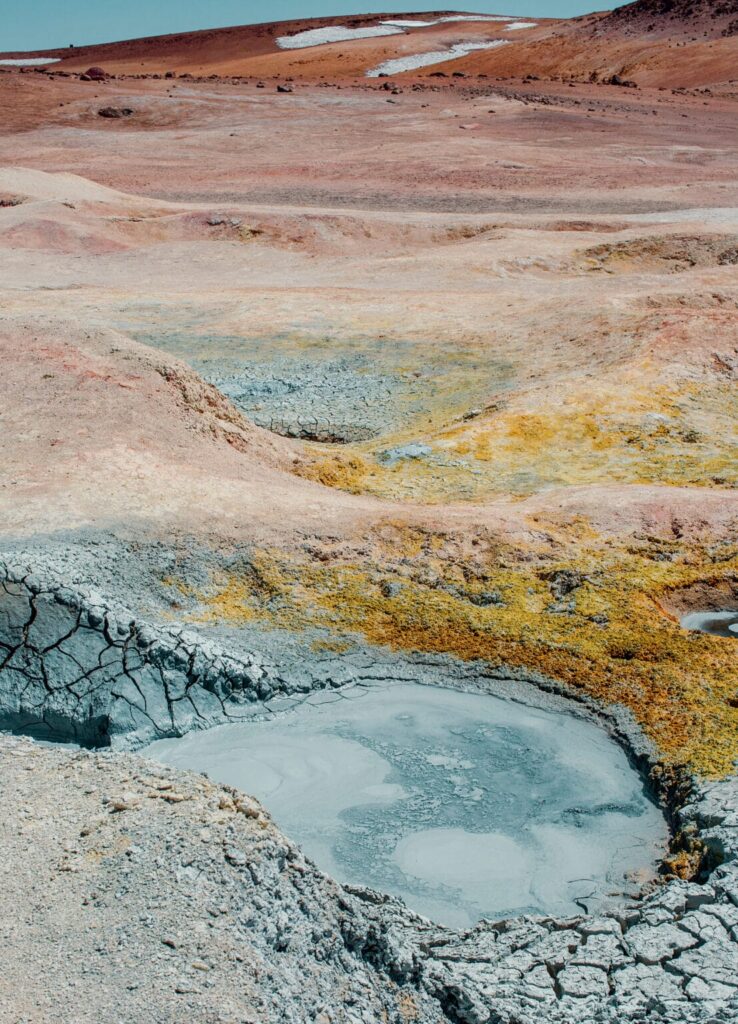
Uyuni Salt Flats (Bolivia). Image source: Chiara Zonca
Effect of processing and human intervention: The appearance and behavior of earth pigments can be further altered (to adjust hue, brightness, and working properties) through post-extraction processes such as:
Drying and grinding – to increase fineness and improve uniformity;
Washing – to remove unwanted impurities;
Calcination (heating) – which alters the chemical structure and color, most notably transforming yellow ochres (goethite) into red ochres (hematite);
Addition of fillers – used to modify hue, texture, or extend pigment volume;
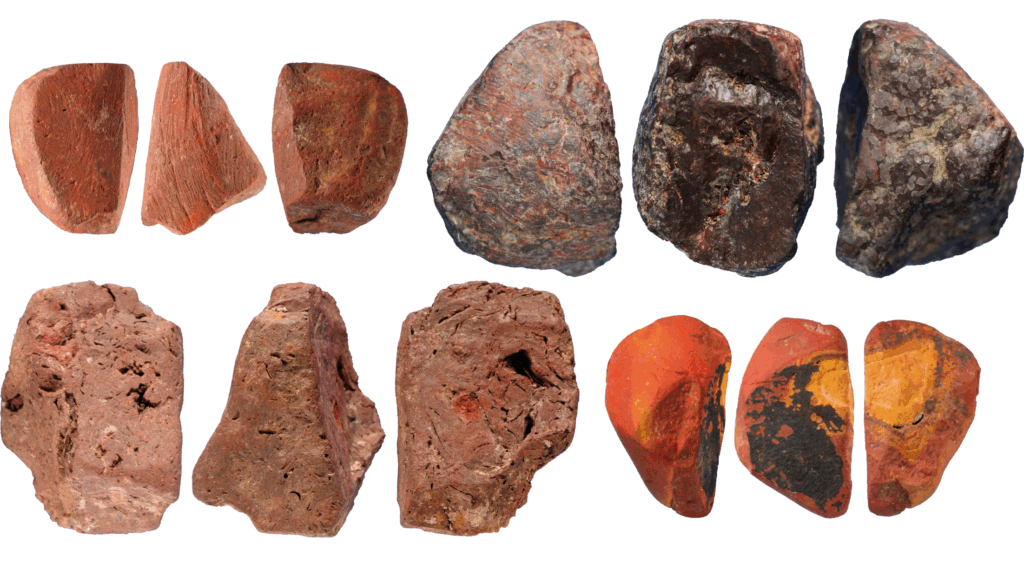
Some of these processing practices were already in use during prehistoric times and reflect an early understanding of how to transform raw geological materials into consistent, workable materials—demonstrating the human capacity to adapt natural resources for artistic and symbolic expression. Found in surface-level deposits, earth pigments were both visible and readily accessible, making them especially appealing to early humans. Archaeological evidence confirms that iron-rich earths have been used for tens of thousands of years to create color.
Ochre fragments found at the Porc-Epic Cave workshop in Ethiopia. Image source: PLOS
Application properties: Earth pigments are valued not only for their color and stability but also for how they behave in practical use. Their key application properties include:
High opacity – resulting from their fine particle size and mineral composition, allowing good coverage even in thin layers.
Matte surface finish – these pigments tend to produce soft, non-glossy coatings, especially in tempera and fresco.
Low tinting strength – generally weaker than synthetic pigments, which can be advantageous for nuanced blending, glazing, or underpainting.
Excellent lightfastness – earth pigments are highly resistant to fading, making them well-suited for a wide range of uses.
Compatibility with various binders – they work well in aqueous (e.g. tempera, watercolor) and oil-based media.
Non-toxicity – most are considered safe to handle, unlike many historical synthetic pigments.
Ease of dispersion – their natural particle morphology allows for good mixing and even distribution in paint formulations.
Earth pigments are commonly classified by their color and mineral composition, yet these categories often overlap due to variations in geological formation, and regional naming traditions. Despite these complexities, a number of broad groupings—such as ochres, umbers, siennas, and green earths—offer a useful framework for understanding their characteristics.
Red Ochres
Main chromophore: Hematite (Fe₂O₃), an anhydrous iron oxide.
Color: Deep reds, oranges, and rust hues; can range from dull brick to vivid vermilion-like tones.
Accessory minerals: Often includes quartz, clays (kaolinite, illite), calcite.
Formation: Can be natural (precipitation or weathering), or through the calcination of goethite.
Variations: Color variation depends heavily onparticle size andhematite morphology — platy or fine particles produce deeper reds, while coarser ones appear more orange.
Formation: Typically formed by weathering of iron-rich rocks in oxidizing environments.
Processing: Often used raw, but can be heat-treated to convert to red ochre (hematite).
Variations: Regional variations in yellow ochre typically reflect differences in accessory minerals—e.g. kaolinite-rich ochres are typically linked to French sources, while gypsum- or sulfate-based ochres are more common in Spanish deposits.
Notable historical sources: France (Roussillon), Spain (Andalusia), Germany (Amberg).
Nomenclature: Includes terms like French ochre, Amberg yellow, often with overlapping or regional meanings.
Brown Ochres and Umbers
Main chromophores: Goethite combined with manganese oxides (e.g. pyrolusite, romanechite).
Color: Warm browns, olive tones, or dark earth colors.
Composition: Umbers typically contain 5–20% manganese oxides. Below 5%, the pigment may be classed as sienna. Accessory minerals: clays, quartz, calcite.
Formation: Weathering of iron- and manganese-rich rocks in oxidizing environments.
Processing:
Raw umber: Cooler and greenish-brown.
Burnt umber: Richer, redder brown due to thermal treatment.
Notable historical sources: Cyprus, Italy (Monte Amiata), Germany, France.
Nomenclature: Includes raw and burnt umber; sometimes regionally labeled (e.g., Cyprus umber).
Siennas
Main chromophore: Goethite, with small amounts (<5%) of manganese oxides.
Color:
Raw sienna: Transparent yellow-brown.
Burnt sienna: Deep reddish-brown.
Formation: Weathering of iron-rich sediments, with low manganese content.
Composition: Higher iron content than umber, lower manganese; often associated with clay-rich matrices.
Processing: Heating enhances the red tones by converting goethite to hematite.
Notable historical sources: Siena, Italy.
Nomenclature: Now refers more to pigment type than provenance; includes raw and burnt variants.
Green Earths
Main chromophores:
Celadonite: Derived from altered volcanic rocks (e.g. Italy, Cyprus).
Glauconite: Derived from marine sedimentary rocks (e.g. Russia, Germany).
Color: Soft greens to greyish-blue greens.
Accessory minerals: Quartz, feldspars, clays.
Formation: Naturally occurring in iron–magnesium-rich environments; celadonite often in basaltic contexts, glauconite in marine sediments.
Nomenclature: “Wad” is a historical miner’s term for black manganese-rich earths.
Humic Earths
Composition: Organic compounds—mainly humic and fulvic acids, alongside clay minerals and iron oxides.
Color: Rich dark brown to nearly black.
Formation: Derived from lignite, peat, or low-grade coal deposits.
Variations: Color intensity may vary with humic content and source.
Notable historical sources: Kassel (Germany), Cologne, and other European lignite deposits.
Nomenclature: Includes names like Vandyke brown, Cassel earth, Cologne earth.
Nomenclature and terminology
The nomenclature of earth pigments is a complex intersection of geology, commerce, history, and artistic tradition. While modern scientific methods aim for clarity and reproducibility, the nomenclature of pigments, and earth pigments in particular, has long been shaped by inconsistent conventions, overlapping terms, and regionally-specific language.
Historically, earth pigments have been labeled based on several (overlapping) criteria:
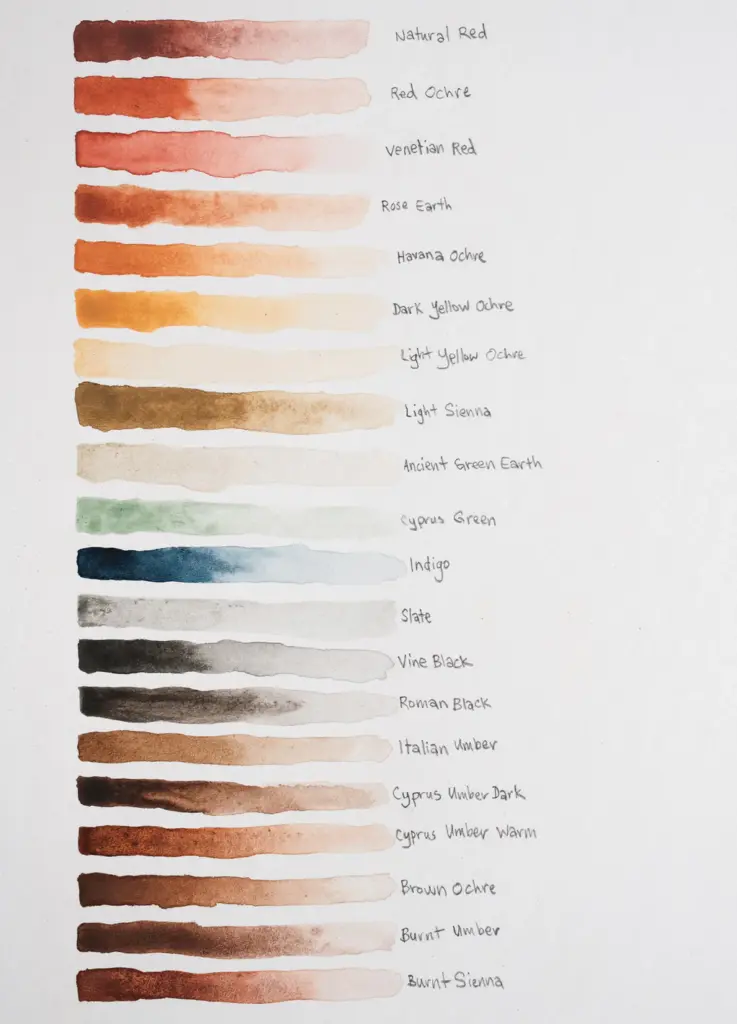
Geographical origin Examples: Verona Green, Cyprus Umber, French Ochre, Pozzuoli Red. These names often reflect the source of extraction — though not always reliably — and have carried associations of quality or prestige (e.g., terra di Siena as a mark of authenticity).
Color and tone Examples: Light Red Ochre, Deep Yellow Ochre, Raw Umber, Burnt Sienna. These names are often descriptive but subjective, influenced by visual perception, particle size, or even preparation method.
Processing method Most notably, the terms raw and burnt indicate whether the pigment has been thermally altered:
Raw sienna (goethite-rich) becomes burnt sienna (hematite-rich).
Raw umber turns into burnt umber with a redder tone due to dehydration of iron and manganese oxides.
Most of these labels, while useful in artistic practice, lack mineralogical precision. The nomenclature of earth pigments is complicated by longstanding inconsistencies and overlapping terminology. A single material may be known by multiple names, as seen in the Colour Index, which lists dozens of synonyms for ochres, siennas, and umbers. For example, several pigments may share the same Colour Index designation—such as PR 102 (C.I. Pigment Red 102) for red ochre—yet differ significantly in composition and origin. One sample might be a fine-grained hematite with high kaolinite content, while another may have a completely different mineralogical profile. Similarly, names like red ochre, Indian red, Venetian red, and Pozzuoli red are often used interchangeably for iron-rich red earth pigment, despite variations in hue, texture, and regional source. Additionally, branding practices by pigment manufacturers introduce ambiguous trade names like Antique Ochre, or Green Earth Light, which offer no reliable indication of mineralogical composition or geographic origin.
Earth pigments in art: history of use
Earth pigments are among the earliest, most enduring materials used in human artistic expression. Their natural beauty, stability, and widespread availability have made them indispensable across cultures and millennia — from Paleolithic burials to contemporary conservation practice.
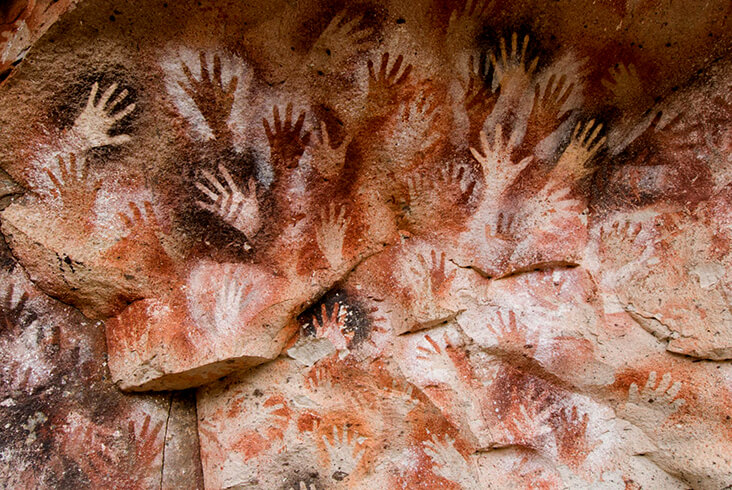
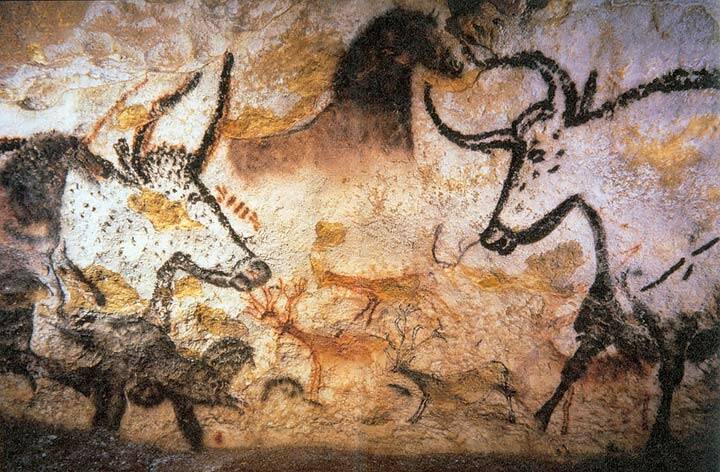
The earliest possible use of ochre identified to date comes from a Homo erectus site found in Kenya estimated to be around 285,000 years old. While this suggests very early engagement with iron-rich pigments, clearer evidence of deliberate ochre processing—such as the presence of raw materials, processing tools and/or storage container—emerges around 100,000 years ago, as evidenced by archaeological discoveries from both Africa and Europe. Red and yellow ochres were used by early Homo sapiens and Neanderthals alike for a range of symbolic and practical purposes. These included body decoration, ritual activities, or burial practices—such as the ochre-covered burial known as the ‘Red Lady’ of Paviland. Ochre was also used extensively in the creation of cave paintings, most famously at sites like Lascaux, Chauvet, and Altamira. In such prehistoric contexts, pigment selection was not purely aesthetic but deeply symbolic. Red ochre, in particular, has long been associated with blood, fertility, life, and transformation, underscoring its powerful cultural significance.
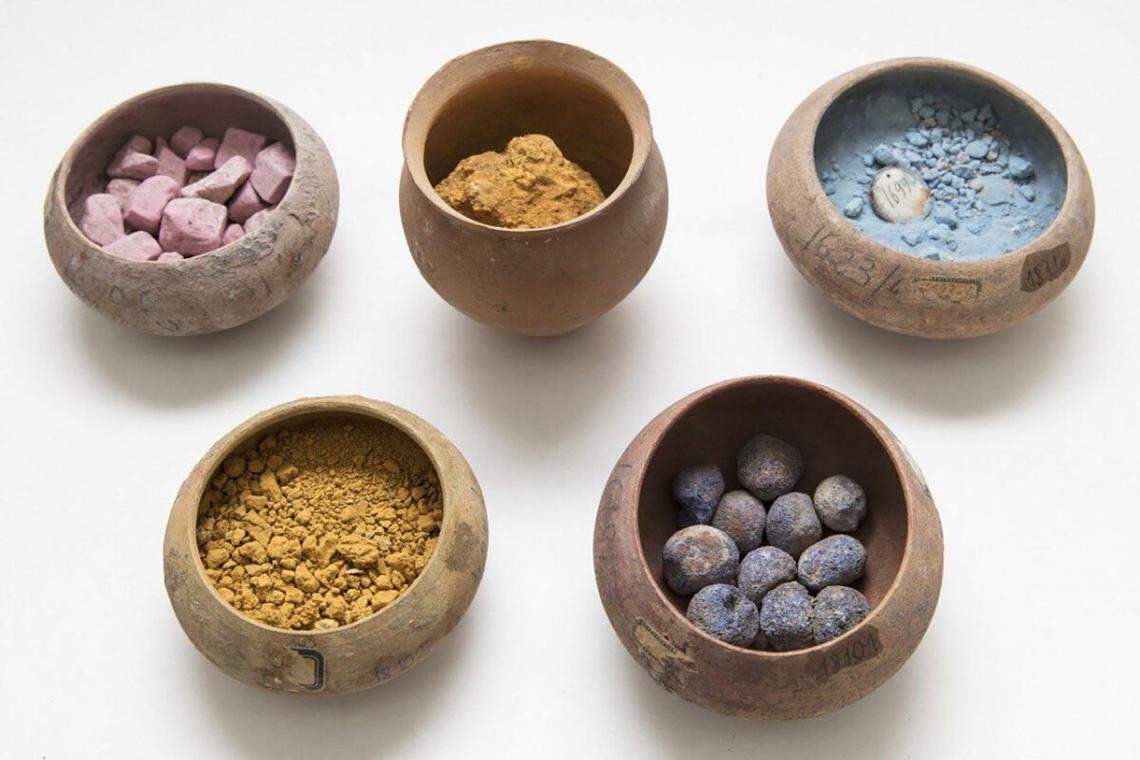
In the ancient world, earth pigments became integral to artistic systems across Egyptian, Mesopotamian, and Mediterranean civilizations. Egyptian wall paintings featured red and yellow ochres, as well as green earths, often combined with synthetic pigments like Egyptian Blue. In Greece and Rome, earth pigments were widely used in frescoes, sculpture polychromy, and architectural decoration. Etruscan tomb paintings relied heavily on earth-based reds and browns to depict human figures and interior scenes. These pigments also played roles beyond painting—used in cosmetics, religious rituals, and body adornment—across both the Mediterranean and regions of South America. While many pigments were locally sourced, trade in earth pigments, particularly high-quality ochres, has been documented throughout the ancient world.
During the Medieval and Renaissance periods, earth pigments formed the core of the artistic palette. Siennas, umbers and green earths were favored for rendering flesh tones, shadows, and underpaintings in panel and manuscript painting. Red ochres, provided a stable and affordable alternative to more expensive pigments such as vermilion or cinnabar. Their lightfastness, non-toxicity, and versatility made them indispensable in fresco, tempera, and early oil techniques.
In the Early Modern period and throughout the Industrial Age (17th–19th centuries), earth pigments remained widely used, though increasingly refined and commercialized. Companies such as Winsor & Newton and Kremer Pigmente began cataloging and distributing standardized earth pigments to professional artists. As academic painting flourished, earth pigments were commonly employed for imprimatura layers or tonal grounds. Even with the rise of synthetic pigments in the 19th century, natural earth pigments retained their appeal, thanks to their compatibility with traditional binders and enduring historical presence. Today, earth pigments continue to be valued in both contemporary art and heritage conservation. Artists seeking sustainable, non-toxic alternatives frequently incorporate them into natural palettes. In conservation, their mineral stability and availability make them ideal for retouching. Additionally, renewed interest in indigenous, vernacular, and community-based practices has brought further attention to the cultural relevance of naturally sourced earth pigments in both historical and living traditions.
Earth pigments in the INFRA-ART Database
The INFRA-ART Spectral Library contains a curated collection of natural earth pigments that currently comprises around 100 samples. These earth pigments span a wide range of hues and geological origins—from iron-rich ochres of Andalusia, green earths from Cyprus, and umbers from Germany and Italy, to unique deposits from Morocco’s Midelt region and volcanic earths near Iceland’s Snæfellsjökull. Sourced from diverse geological settings, these pigments exhibit variations in origin, mineral composition, and preparation methods, including fired variants such as burnt sienna and burnt umber. Their complex chemistry often involves mixtures of chromophore minerals (iron and manganese oxides/hydroxides) with accessory phases. Such compositions, together with distinctive geochemical fingerprints, make them valuable for provenance studies. Most samples have been analyzed via ATR-FTIR and XRF, with Raman and SWIR reflectance datasets currently in preparation. The database is periodically updated, with new samples added to expand its pigment diversity and analytical coverage.
Red Ochres
Sample name
Provenance
Sample ID
Pigment supplier
Spectral data
Red Ochre from Andalusia
Andalusia, Spain
PK11273
Kremer
FTIR, XRF, Raman
Red Ochre from Burgundy
Burgundy, France
PK11575
Kremer
FTIR, XRF, Raman
Red Ochre from Burgundy (dark)
Burgundy, France
PK11577
Kremer
FTIR, XRF
Red Ochre from Castille
Castille, Spain
PK11584
Kremer
FTIR, XRF, Raman
Red Ochre from Iceland
Snæfellsjökull, Iceland
PK11550
Kremer
FTIR, XRF, Raman
Red Moroccan Ochre (dark)
Midelt, Morocco
PK116440
Kremer
FTIR, XRF
Red Moroccan Ochre (fine)
Midelt, Morocco
PK116431
Kremer
FTIR, XRF, Raman
French Ochre RTFLES (washed)
France
PK40020
Kremer
FTIR, XRF
French Ochre SOFOROUGE
France
PK40090
Kremer
FTIR, XRF
Persian Red
Hormuz, Iran
PK17280
Kremer
FTIR, XRF
Red Bole
Germany
PK40503
Kremer
FTIR, XRF
Bole (ruby)
n/s
PK58270
Kremer
FTIR, XRF
Haematite (intense tinting)
n/s
PK48651
Kremer
FTIR, XRF
Red ochres samples and available spectral data
Yellow Ochres
Sample name
Provenance
Sample ID
Pigment supplier
Spectral data
Yellow Ochre (deep)
n/s
PK40301
Kremer
FTIR, XRF
Yellow Ochre from Andalusia
Andalusia, Spain
PK11272
Kremer
FTIR, XRF, Raman
Yellow Ochre from Burgundy
Burgundy, France
PK11573
Kremer
FTIR, XRF, Raman
Yellow Ochre from Iceland
Snæfellsjökull, Iceland
PK11551
Kremer
FTIR, XRF, Raman
Yellow Ochre (light)
n/s
PM132
Maimeri
FTIR, XRF
French Ochre (extra light)
France
PK40013
Kremer
FTIR, XRF
French Ochre JCLES (washed)
France
PK40040
Kremer
FTIR, XRF
French Ochre JFLES (washed)
France
PK40050
Kremer
FTIR, XRF
French Ochre JOLES (washed)
France
PK40030
Kremer
FTIR, XRF
French Ochre JTCLES (washed)
France
PK40010
Kremer
FTIR, XRF
French Ochre SAHARA
France
PK40130
Kremer
FTIR, XRF
French Ochre SOFODOR (golden)
France
PK40070
Kremer
FTIR, XRF
Satin Ochre, Monte Amiata (gold-orange)
Tuscany, Italy
PK40260
Kremer
FTIR, XRF, Raman
Taunus Ochre (light)
Hesse region, Germany
PK11540
Kremer
FTIR, XRF, Raman
Gold Ochre from Poland
Carpathian Mountains, Poland
PK40195
Kremer
FTIR, XRF, Raman
Gold Ochre from Germany
Saxony, Germany
PK11530
Kremer
FTIR, XRF, Raman
Gold Ochre
n/s
PSC18621
Schmincke
FTIR, XRF
Italian Gold Ochre (light)
Venice, Italy
PK40220
Kremer
FTIR, XRF, Raman, SWIR
Ochre Avana (greenish-yellow)
Italy
PK40200
Kremer
FTIR, XRF, Raman
Bole (yellow)
n/s
PK58275
Kremer
FTIR, XRF
Yellow ochres samples and available spectral data
Brown Ochres and Umbers
Sample name
Provenance
Sample ID
Pigment supplier
Spectral data
Brown Earth from Otranto
Otranto, Italy
PK11620
Kremer
FTIR, XRF, Raman
Brown Ochre from Andalusia
Andalusia, Spain
PK11276
Kremer
FTIR, XRF, Raman
Caledonian Brown
Morocco
PK40623
Kremer
FTIR, XRF, Raman
German Brown Ochre (light)
Germany
PK40231
Kremer
FTIR, XRF, Raman
Raw Umber from Cyprus
Cyprus
PK40610
Kremer
FTIR, XRF, Raman
Raw Umber from Cyprus (light)
Cyprus
PK40611
Kremer
FTIR, XRF
Raw Umber from Cyprus (slightly greenish)
Cyprus
PK40660
Kremer
FTIR, XRF
Raw Umber from Italy (greenish)
Italy
PK40612
Kremer
FTIR, XRF, Raman, SWIR
Fawn Ochre (very light umber, greenish)
Germany
PK40241
Kremer
FTIR, XRF, Raman
Brown ochres/umbers samples and available spectral data
Siennas
Sample name
Provenance
Sample ID
Pigment supplier
Spectral data
Raw Sienna, French
France
PK40392
Kremer
FTIR, XRF, Raman
Raw Sienna, Italian
Tuscany, Italy
PK40400
Kremer
FTIR, XRF, Raman, SWIR
Raw Sienna, Italian (brownish)
Tuscany, Italy
PK40410
Kremer
FTIR, XRF, Raman
Raw Sienna Badia, Italian
Badia, Italy
PK40404
Kremer
FTIR, XRF, Raman
Natural Sienna
Grosseto, Italy
PK17050
Kremer
FTIR, XRF
Raw Sienna Light
n/s
PM162
Maimeri
FTIR, XRF
Siennas samples and available spectral data
Burnt Siennas and Burnt Umbers
Sample name
Provenance
Sample ID
Pigment supplier
Spectral data
Italian Burnt Sienna
Italy
PK40430
Kremer
FTIR, XRF, Raman, SWIR
Burnt Sienna
n/s
PSE211
Sennelier
FTIR, XRF, Raman, SWIR
Burnt Umber
n/s
PM492
Maimeri
FTIR, XRF
Burnt Umber
Cyprus
PK40723
Kremer
FTIR, XRF
Burnt Umber (reddish-brown)
Cyprus
PK40730
Kremer
FTIR, XRF
Burnt Umber from Cyprus (brownish)
Cyprus
PK40710
Kremer
FTIR, XRF, Raman
Burnt Umber from Cyprus (dark brown)
Cyprus
PK40720
Kremer
FTIR, XRF
Burnt Green Earth (reddish)
n/s
PK40850
Kremer
FTIR, XRF
French Burnt Sienna
France
PK40470
Kremer
FTIR, XRF
Burnt siennas/umbers samples and available spectral data
Green Earths
Sample name
Provenance
Sample ID
Pigment supplier
Spectral data
Green Earth (yellowish)
Germany
PK40800
Kremer
FTIR, XRF
Green Earth from Cyprus
Cyprus
PK17400
Kremer
FTIR, XRF, Raman
Green Earth from Cyprus (bluish)
Cyprus
PK17410
Kremer
FTIR, XRF, Raman
Green Earth from Iceland
Snæfellsjökull, Iceland
PK11552
Kremer
FTIR, XRF, Raman
Russian Green Earth
Russia
PK11110
Kremer
FTIR, XRF, Raman
Russian Green Earth (extra fine)
Russia
PK11111
Kremer
FTIR, XRF
Bavarian Green Earth
Bavaria, Germany
PK11100
Kremer
FTIR, XRF, Raman
Verona Green Earth
Monte Baldo, Verona, Italy
PK11010
Kremer
FTIR, XRF, Raman
Bole (green)
n/s
PK58273
Kremer
FTIR, XRF
Green earth samples and available spectral data
Black and Violet Earths
Sample name
Provenance
Sample ID
Pigment supplier
Spectral data
Black Earth from Andalusia
Andalusia, Spain
PK11280
Kremer
FTIR, XRF, Raman
Bole (violet)
n/s
PK58272
Kremer
FTIR, XRF
Iron Glimmer Violet
n/s
PK48930
Kremer
FTIR, XRF
Iron Glimmer Violet (extra fine)
n/s
PK48933
Kremer
FTIR, XRF
Black and violet earth samples and available spectral data
Humic Earths
Sample name
Provenance
Sample ID
Pigment supplier
Spectral data
Van Dyck Brown
Germany
PK41050
Kremer
FTIR, XRF
Van Dyck Brown (dark)
Germany
PK41000
Kremer
FTIR, XRF
Humic earth samples and available spectral data
Further reading and resources
Asscher, Y. et al. (2025). Implementation of Red Ochre in Sinopia: Non-invasive characterization of the invisible frescos beneath Roman and Byzantine mosaics in Judea. Journal of Archaeological Science 175, 106146. https://doi.org/10.1016/j.jas.2024.106146
Becker, H. (2022). Pigment nomenclature in the ancient Near East, Greece, and Rome. Archaeological and Anthropological Sciences 14, 20. https://doi.org/10.1007/s12520-021-01394-1
Cortea, I.M. et al (2022). Assessment of Easily Accessible Spectroscopic Techniques Coupled with Multivariate Analysis for the Qualitative Characterization and Differentiation of Earth Pigments of Various Provenance. Minerals 12(6), 755. https://doi.org/10.3390/min12060755
Domingo, I. and Chieli, A. (2021). Characterizing the pigments and paints of prehistoric artists. Archaeological and Anthropological Sciences 13, 166. https://doi.org/10.1007/s12520-021-01397-y
Eastaugh, N. et al. (2008). Pigment Compendium: A Dictionary and Optical Microscopy of Historical Pigments, 1st ed., Routledge.
Feller, R.L., and Johnston-Feller, R.M. (1997) Vandyke Brown. In “Artists’ Pigments: A Handbook of Their History and Characteristics”, vol. 3, ed. Fitzhugh, E.W., Archetype Publications, pp. 157-190.
Grifa, C. et al. (2025). Pompeian pigments. A glimpse into ancient Roman colouring materials. Journal of Archaeological Science, 106201. https://doi.org/10.1016/j.jas.2025.106201
Grissom, C.A. (1986) Green Earth. In “Artists’ Pigments: A Handbook of Their History and Characteristics”, vol. 1, ed. Feller, R.L., Archetype Publications, pp. 141-167.
Gustafson, H. (2023). Book of Earth: A Guide to Ochre, Pigment and Raw Color. Abrams.
Helwig, K. (2007). Iron Oxide Pigments: Natural and Synthetic. In “Artists’ Pigments: A Handbook of Their History and Characteristics”, vol. 4, ed. Berrie, B.H., Archetype Publications, pp. 39-109.
Hirst, K.K. (2025, Apr 3). Ochre – The Oldest Known Natural Pigment in the World. ThoughtCo. Available online
Knapp, C.W. et al. (2021). The ecology and bioactivity of some Greco-Roman medicinal minerals: the case of Melos earth pigments. Archaeological and Anthropological Sciences 13, 166. https://doi.org/10.1007/s12520-021-01396-z
Marketou, A., and Rodler, A. (2025). Ochres as earth pigments in Hellenistic and Roman polychromy: State of the art and future directions on material origins and trade. Journal of Archaeological Science 180, 106276. https://doi.org/10.1016/j.jas.2025.106276
Mastrotheodoros, G.P., and Beltsios, K.G. (2022). Pigments—Iron-based red, yellow, and brown ochres. Archaeological and Anthropological Sciences 14, 35. https://doi.org/10.1007/s12520-021-01482-2
Montagner, C. at al. (2013). Ochres and earths: Matrix and chromophores characterization of 19th and 20th century artist materials. Spectrochimica Acta Part A: Molecular and Biomolecular Spectroscopy 103, 409-416. https://doi.org/10.1016/j.saa.2012.10.064
O’Hanlon, G. (2023, Feb 19). Yellow Ochre: A Comprehensive Guide to Its History, Properties, and Uses. Natural Pigments. Available online
Popelka-Filcoff, R.S., and Zipkin, A.M. (2022). The archaeometry of ochre sensu lato: A review. Journal of Archaeological Science 137, 105530. https://doi.org/10.1016/j.jas.2021.105530
Rosso, D.E., Martí, A.P., d’Errico, F. (2016). Middle Stone Age Ochre Processing and Behavioural Complexity in the Horn of Africa: Evidence from Porc-Epic Cave, Dire Dawa, Ethiopia. PLoS ONE 11(11), e0164793. https://doi.org/10.1371/journal.pone.0164793
Siddall, R. (2018). Mineral pigments in archaeology: Their analysis and the range of available materials. Minerals 8(5), 201. https://doi.org/10.3390/min8050201
Velliky, E.C. et al. (2024). The Framework for Ochre Experiences (Foes): Towards a Transdisciplinary Perspective on the Earth Material Heritage of Ochre. In: Abadía, O.M., Conkey, M.W., McDonald, J. (eds) Deep-Time Images in the Age of Globalization. Interdisciplinary Contributions to Archaeology. Springer, Cham. https://doi.org/10.1007/978-3-031-54638-9_8
How to cite this resource
Cortea, I.M. (2025). INFRA-ART spectral data collections: earth pigments. INFRA-ART Blog